
Music is often called a universal language, but every language needs signs and structure to communicate clearly. In music, small notation marks guide musicians through rhythm, pitch, timing, volume, and expression.
From the treble clef printed on piano sheets to tiny rhythm marks inside orchestras, these symbols shape how songs are played and understood across the world.
Whether someone is learning piano, guitar, violin, singing, or beginner music theory, understanding musical symbols is one of the first steps toward reading sheet music confidently.
Today, people search for musical symbols charts, music note meanings, and lists of musical symbols because these signs appear everywhere:
- Sheet music
- Piano lessons
- Music apps
- Choir books
- Tattoos
- Digital compositions
- Music theory classes
Some notation signs are simple and easy to recognize. Others carry deeper artistic symbolism connected with creativity, memory, tension, storytelling, and personal expression.
Musical Symbols Chart for Beginners
This beginner-friendly musical symbols chart helps explain common notation signs used in sheet music.
| Musical Symbol | Name | Meaning |
| 𝄞 | Treble Clef | High-pitched notes |
| 𝄢 | Bass Clef | Low-pitched notes |
| ♩ | Quarter Note | One beat |
| ♪ | Eighth Note | Half beat |
| ♫ | Beamed Notes | Connected rhythm |
| 𝄐 | Fermata | Hold note longer |
| ♯ | Sharp | Raise pitch |
| ♭ | Flat | Lower pitch |
| ♮ | Natural | Cancel sharp or flat |
| p | Piano | Play softly |
| f | Forte | Play loudly |
| > | Accent | Emphasize note |
| . | Staccato | Short detached note |
| 𝄇 | Repeat Sign | Repeat section |
What Are Musical Symbols?
Musical symbols are written notation signs that explain how music should be played, sung, or performed.
These notation marks help musicians understand:
- Rhythm
- Pitch
- Tempo
- Dynamics
- Timing
- Volume
- Musical mood
- Playing style
Without music notation, reading sheet music would become extremely difficult.
Just like punctuation changes the tone of written sentences, melodic symbols change how songs sound and feel.
For example:
- A single dot can completely change how a note is played
- A sharp sign changes pitch instantly
- Dynamic markings can transform soft melodies into dramatic musical moments
Because of this, notation systems do more than organize sound. They also communicate artistic feeling and creative expression.
Why Musical Symbols Still Matter Today
Even in the digital music era, traditional notation remains important.
Modern musicians still rely on notation signs in:
- Piano lessons
- Guitar tabs
- Orchestra performances
- Choir music
- Film scoring
- Songwriting
- Music production software
- Music education apps
Beginner piano students usually recognize the treble clef first because it appears in most starter sheet music and learning apps.
Digital composing tools still depend heavily on traditional notation because musicians worldwide understand the same rhythmic markings regardless of language.
That practical consistency is one reason music notation continues surviving across generations.
History of Musical Symbols
Music notation dates back more than 1,000 years.
Early civilizations used simple markings to record melodies, but modern sheet music systems gradually developed through medieval Europe.
Ancient monks used notation signs called neumes to guide religious chants. Over time, those markings evolved into modern staff notation.
Important developments included:
- Clef symbols
- Time signatures
- Rhythm notation
- Dynamic markings
- Expression signs
Italian musical terms later became universal in music theory, which explains why many notation instructions still use Italian words today.
Even modern composers continue using centuries-old notation traditions because they remain globally understood.
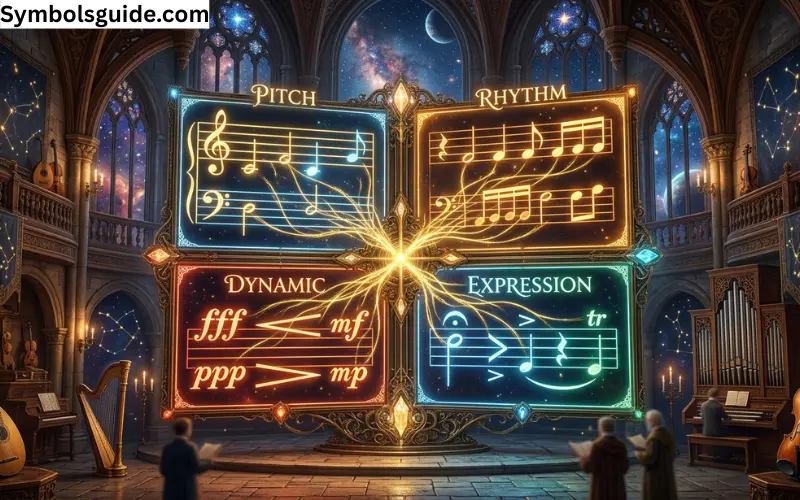
Main Types of Musical Symbols
Music notation contains several categories of expressive signs and rhythmic markings.
Pitch Symbols
Pitch symbols show how high or low notes should sound.
Common pitch symbols include:
- Treble clef
- Bass clef
- Sharp
- Flat
- Natural
Rhythm Symbols
Rhythm symbols explain note length and timing.
Examples include:
- Whole notes
- Half notes
- Quarter notes
- Eighth notes
- Rests
Dynamic Symbols
Dynamics control musical volume and intensity.
Examples include:
- Piano (soft)
- Forte (loud)
- Crescendo
- Decrescendo
Expression Symbols
Expression signs shape musical style and feeling.
Examples include:
- Accent marks
- Staccato
- Slurs
- Fermata
Common Musical Symbols Names
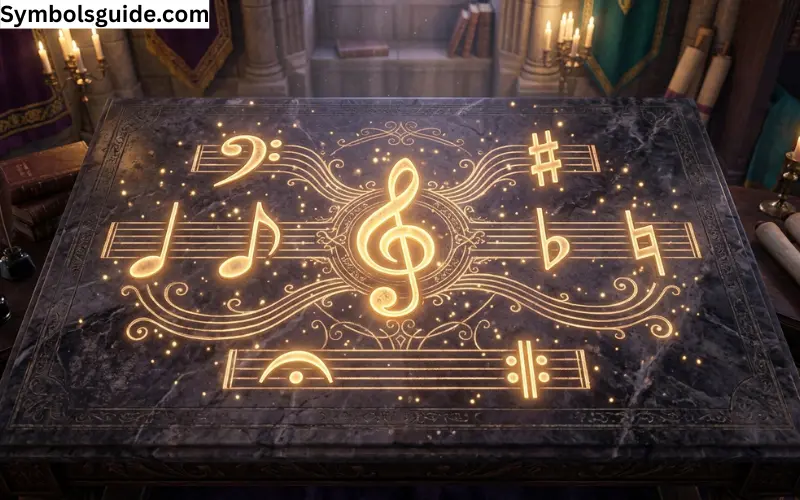
Many beginners search for musical symbols names while learning sheet music for the first time.
Clef Symbols
- Treble Clef
- Bass Clef
- Alto Clef
- Tenor Clef
Rhythm Symbols
- Whole Note
- Half Note
- Quarter Note
- Eighth Note
- Sixteenth Note
Dynamic Symbols
- Piano (p)
- Forte (f)
- Mezzo Piano (mp)
- Mezzo Forte (mf)
Expression Marks
- Staccato
- Accent
- Slur
- Fermata
Music Note Symbols and Meanings
Music note symbols are usually the first notation signs beginners learn while studying rhythm and counting.
| Music Note Symbol | Name | Function |
| 𝅝 | Whole Note | Four beats |
| 𝅗𝅥 | Half Note | Two beats |
| ♩ | Quarter Note | One beat |
| ♪ | Eighth Note | Half beat |
For new music students, rhythm notation often feels more confusing than recognizing note names.
Music teachers commonly introduce quarter notes before complex rhythm patterns because beginners usually learn counting more comfortably step by step.
How to Read Musical Symbols for Beginners
Learning sheet music can feel overwhelming at first, especially when dozens of notation signs appear together on a page.
Most music teachers recommend learning gradually instead of memorizing everything at once.
Here are some beginner-friendly steps:
- Start by learning treble clef and bass clef symbols
- Practice identifying note values slowly
- Count rhythms out loud
- Learn timing before speed
- Recognize dynamic markings like piano and forte
- Practice short pieces consistently
For beginner piano students, rhythm timing often becomes more difficult than identifying note positions.
With regular practice, notation symbols eventually become easier to recognize naturally.
Printable Musical Symbols Chart
Many beginners use printable musical symbols charts while practicing piano or reading sheet music.
Printable notation charts are especially useful for:
- Beginner piano lessons
- Music classrooms
- Homeschool music study
- Guitar practice
- Quick rhythm reference
Some students keep small notation charts beside their keyboards while practicing scales and beginner songs.
List of Musical Symbols and Their Meanings
1. Treble Clef Symbol
Meaning
The treble clef is one of the most recognized notation signs in the world.
It represents higher-pitched notes and is commonly used for:
- Piano right hand
- Violin
- Flute
- Vocals
- Guitar
The symbol circles around the G line on the musical staff, which is why it’s also called the G Clef.
Artistic Interpretation
The treble clef is often associated with creativity, identity, passion, and love for music.
Music-inspired tattoos featuring the treble clef have become popular because the symbol feels both elegant and personal.
Where It Appears
- Sheet music
- Music logos
- Tattoos
- Jewelry
- Music classrooms
2. Bass Clef Symbol
Meaning
The bass clef represents lower-pitched notes.
It is commonly used for:
- Piano left hand
- Bass guitar
- Cello
- Tuba
- Trombone
The two dots surround the F line, which is why it’s also called the F Clef.
Symbolic Interpretation
The bass clef is frequently connected with depth, grounding, and musical balance because it supports harmony underneath melodies.
Beginner piano students often confuse bass clef and treble clef during early lessons because both symbols look visually complex at first.
3. Sharp Symbol (♯)
Meaning
The sharp symbol raises a note by one semitone.
Examples include:
- C becomes C♯
- F becomes F♯
Sharps help musicians change keys and create brighter melodic moods.
Musical Feeling
Sharp notes often sound:
- Energetic
- Bright
- Uplifting
- Intense
4. Flat Symbol (♭)
Meaning
The flat symbol lowers a note by one semitone.
Examples include:
- B becomes B♭
- E becomes E♭
Flat keys are often associated with softer or calmer tonal qualities.
Artistic Interpretation
Some musicians describe flat scales as:
- Warmer
- Gentler
- Reflective
- Smooth
5. Natural Symbol (♮)
Meaning
The natural symbol cancels previous sharps or flats.
It returns notes back to their original pitch.
Without natural signs, reading sheet music could become confusing very quickly.
6. Quarter Note Symbol
Meaning
The quarter note usually receives one beat in common time.
It is one of the first rhythmic markings beginners learn while studying music theory.
Why It Matters
Understanding quarter notes helps musicians improve:
- Rhythm
- Timing
- Coordination
- Counting skills
7. Eighth Note Symbol
Meaning
Eighth notes are shorter rhythm symbols worth half a beat.
They often appear connected together with beams.
Musical Effect
Eighth notes create:
- Movement
- Momentum
- Flow
- Energy
Fast songs commonly use groups of eighth notes to increase musical intensity.
8. Fermata Symbol
Meaning
The fermata tells musicians to hold a note longer than normal.
The exact duration depends on the conductor or performer.
Emotional Effect
Fermatas often create:
- Suspense
- Reflection
- Tension
- Dramatic pauses
In emotional songs, these pauses can feel incredibly powerful.
9. Forte Symbol (f)
Meaning
Forte means “play loudly.”
It increases dramatic intensity and musical power.
Emotional Feeling
Loud dynamics often communicate:
- Excitement
- Passion
- Confidence
- Drama
- Strength
10. Piano Symbol (p)
Meaning
Piano means “play softly.”
Soft dynamics create gentle musical atmosphere.
Emotional Feeling
Soft music often feels:
- Calm
- Intimate
- Reflective
- Peaceful
- Melancholic
Complete List of Musical Symbols
| Symbol | Name | Function |
| ♯ | Sharp | Raise pitch |
| ♭ | Flat | Lower pitch |
| ♮ | Natural | Cancel alteration |
| 𝄞 | Treble Clef | High notes |
| 𝄢 | Bass Clef | Low notes |
| p | Piano | Soft volume |
| f | Forte | Loud volume |
| > | Accent | Stress note |
| . | Staccato | Short note |
| 𝄐 | Fermata | Hold note |
| 𝄇 | Repeat Sign | Repeat section |
| ♪ | Eighth Note | Half beat |
Common Musical Symbols Beginners Confuse
Many new music students confuse similar-looking notation signs while learning sheet music.
| Symbol Pair | Why Beginners Confuse Them |
| Sharp vs Flat | Both change pitch |
| Treble Clef vs Bass Clef | Different clef systems |
| Quarter Note vs Eighth Note | Similar note shapes |
| Staccato vs Accent | Both affect playing style |
Music teachers often recommend learning notation symbols slowly instead of trying to memorize everything immediately.
With regular practice, most symbols eventually become easier to recognize naturally.
Common Mistakes Beginners Make While Learning Musical Symbols
While learning notation systems, beginners commonly struggle with:
- Confusing rhythm timing
- Ignoring rests
- Mixing treble and bass clefs
- Forgetting dynamics
- Counting incorrectly
- Playing notes too quickly
- Memorizing symbols without practicing rhythm
For beginner musicians, timing usually becomes more difficult than recognizing symbols visually.
That’s why teachers often encourage slow repetition instead of rushing through lessons.
Musical Symbols Crossword Clue Meanings
Crossword puzzles frequently include music notation clues.
Common musical symbols crossword clue answers include:
- Clef
- Rest
- Sharp
- Flat
- Note
- Staff
- Tempo
- Fermata
People often search these terms while solving music-themed crossword puzzles and word games.
Hidden Symbolism Behind Musical Notation
One thing many music theory articles overlook is the artistic and psychological side of notation systems.
These expressive signs do more than organize sound.
They shape feeling and atmosphere inside music.
For example:
- Crescendo markings slowly build tension
- Staccato notes create sharp energy
- Slurs create smooth musical flow
- Fermatas create suspense and reflection
Even today, musicians still depend on these tiny notation signs to transform written notes into real sound and feeling.
Musical Symbol Tattoo Meanings
Musical symbol tattoos remain incredibly popular because they combine artistic beauty with personal symbolism.
Music-inspired tattoos are often connected with:
- Creativity
- Personal memories
- Healing
- Passion
- Identity
- Emotional attachment
Some people choose music tattoos to honor loved ones, meaningful songs, or important life experiences.
Popular Musical Symbol Tattoos
Treble Clef Tattoo Meaning
Often connected with creativity, identity, and lifelong love for music.
Bass Clef Tattoo Meaning
Represents depth, balance, and emotional grounding.
Music Note Heart Tattoo
Usually symbolizes relationships, memories, and artistic passion.
Infinity Music Symbol Tattoo
Combines infinity signs with notes to represent endless love for music.
Piano Key Tattoo Symbolism
Frequently associated with musical dedication, learning, and self-expression.
Memorial Music Tattoos
Some people choose music-inspired tattoos to honor musicians, family members, or meaningful songs connected with important memories.
Matching Couple Music Tattoos
Matching notation tattoos have become popular among couples who share strong emotional connections through music.
Minimalist Music Note Tattoos
Minimal music note designs are often chosen because they look elegant, modern, and visually clean.
Many people also explore detailed treble clef tattoo meanings before choosing music-inspired artwork.
Musical Symbols in Digital Music Today
Even modern digital music software still depends heavily on traditional notation systems.
Music technology continues using notation signs for:
- MIDI editing
- Orchestra scoring
- Film composition
- Piano roll timing
- Virtual instruments
Despite advances in music production technology, notation remains the universal written language of music.
Why Musical Symbols Are Popular on Social Media
Music aesthetics have become extremely popular across:
- TikTok
- Digital art communities
- Tattoo culture
Treble clefs, piano keys, vinyl records, and music notes frequently appear in:
- Wallpapers
- Tattoos
- Profile designs
- Digital edits
- Jewelry designs
People often connect with music-inspired imagery because it represents creativity, identity, healing, memory, and self-expression.
See Also
FAQs
What are musical symbols called?
Musical symbols are commonly called music notation symbols. These written signs help musicians understand rhythm, pitch, tempo, dynamics, timing, and playing style while reading sheet music. They create a universal system musicians can understand across different instruments and countries.
What is the most common musical symbol?
The treble clef is one of the most recognized notation signs because it appears in beginner piano music, vocal music, guitar notation, and school music lessons. Most musicians learn the treble clef before any other notation symbol because it is widely used in beginner sheet music.
Why are musical symbols important?
Musical symbols help musicians communicate sound accurately through written notation. Without these symbols, understanding rhythm, pitch, timing, and musical dynamics would become extremely difficult, especially in orchestras, choirs, and advanced musical compositions.
What does the sharp symbol mean in music?
The sharp symbol raises a musical note by one semitone. Musicians use sharps to change pitch, build scales, create harmonies, and produce brighter or more energetic musical moods inside songs and compositions.
Why do people get musical symbol tattoos?
People choose musical symbol tattoos because they often represent creativity, artistic identity, emotional memories, healing, passion, and personal connection with music. Treble clefs and music note tattoos remain especially popular in music-inspired tattoo culture.
Are musical symbols universal?
Most modern musical symbols are internationally recognized, especially in Western music notation. This allows musicians from different countries to read the same sheet music and perform together even if they speak different languages.
Conclusion
Musical symbols remain one of the most important parts of written music because they turn sound into a visual language musicians can understand worldwide.
Behind every clef, note, sharp sign, and dynamic marking is a notation system designed to express rhythm, movement, tension, creativity, and feeling.
Whether someone is learning piano, studying beginner music theory, choosing a tattoo, or reading sheet music for the first time, understanding notation signs opens the door to deeper musical expression.
Even after centuries of change, musicians still depend on these small notation signs to share rhythm, creativity, memory, and feeling through music.