
Some ancient symbols disappeared with the civilizations that created them.
Others somehow survived for thousands of years.
Even today, these mysterious signs continue appearing in tattoos, jewelry, mythology, spiritual artwork, and personal keepsakes because they still express emotions words sometimes cannot fully explain.
Long before modern language existed, civilizations used mystical markings to express beliefs, rituals, emotions, identity, and sacred traditions.
These historical motifs appeared in temples, cave paintings, burial sites, sacred jewelry, mythology, and ancient architecture across the world.
Not every ancient sign survived history.
Some vanished completely.
Others became more powerful over time.
From Egyptian iconography and Celtic knotwork to Norse emblems and Eastern spiritual motifs, these timeless designs continue influencing tattoos, gaming culture, fashion, spirituality, jewelry, and social media aesthetics.
Ancient Symbols Chart for Beginners
This printable ancient symbols chart helps beginners quickly understand some of the world’s most recognized spiritual motifs and their meanings.
| Symbol | Culture | Core Meaning | Common Modern Use |
| Ankh | Egyptian | Life and immortality | Tattoos, jewelry |
| Ouroboros | Greek/Egyptian | Eternal cycles | Spiritual art |
| Eye of Horus | Egyptian | Protection and healing | Tattoos, fashion |
| Valknut | Norse | Death and afterlife | Viking artwork |
| Tree of Life | Multiple Cultures | Growth and connection | Tattoos, wall art |
| Lotus Flower | Eastern | Spiritual awakening | Meditation culture |
| Yin Yang | Chinese | Balance and harmony | Spiritual symbolism |
| Triquetra | Celtic | Unity and eternity | Jewelry and tattoos |
| Scarab Beetle | Egyptian | Transformation | Ancient-inspired art |
| Spiral Symbol | Ancient Europe | Personal evolution | Spiritual designs |
What Are Ancient Symbols?
Ancient symbols are visual signs created by early civilizations to represent spirituality, beliefs, emotions, sacred knowledge, and natural forces.
Unlike modern logos or decorative artwork, these mystical motifs often carried deep cultural or religious importance.
These sacred markings commonly appeared in:
- Temples
- Sacred texts
- Tombs
- Jewelry
- Ritual ceremonies
- Ancient weapons
- Mythology
- Historical architecture
Historians believe symbolic communication existed long before formal written language developed.
Some mythological emblems represented divine protection or cosmic balance.
Others reflected rebirth, fertility, destiny, wisdom, healing, or the cycle of life and death.
Today, these cultural iconographies still appear in tattoos, gaming culture, fashion, spiritual communities, and modern artwork.
Why Ancient Symbols Still Matter Today
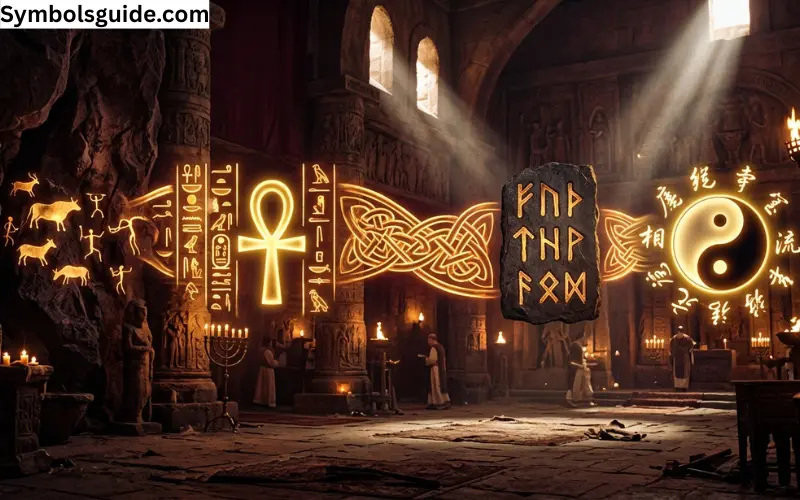
Even after thousands of years, people still feel emotionally connected to these mysterious emblems.
The reason is simple.
The meanings behind these sacred designs still relate to modern human experiences.
People are naturally drawn toward imagery connected with:
- Love
- Healing
- Protection
- Identity
- Inner strength
- Rebirth
- Spiritual growth
- Personal transformation
Tattoo artists frequently describe ancient-inspired artwork as timeless because it combines beauty, mystery, history, and emotional meaning in one image.
Social platforms like Pinterest, TikTok, and Instagram have also increased interest in ritual imagery and spiritual motifs, especially among people exploring mythology, tattoos, spirituality, and self-discovery.
People discovering mythology for the first time often feel overwhelmed because many sacred emblems changed meaning across cultures and historical periods.
That complexity is part of what makes ancient iconography so fascinating.
History of Ancient Symbols
Symbolic communication dates back thousands of years.
Early humans carved mysterious shapes into cave walls long before modern writing systems existed.
Over time, civilizations developed advanced symbolic systems connected with astronomy, mythology, religion, leadership, and cultural traditions.
Important civilizations known for symbolic imagery include:
- Ancient Egypt
- Greece
- Rome
- Celtic societies
- Norse cultures
- China
- India
- Mesopotamia
- Indigenous tribal communities
Some spiritual markings remained sacred for centuries because people believed they carried supernatural or divine power.
Others became linked with themes like sacrifice, eternal love, destiny, healing, wisdom, and life after death.
Ancient Symbols From Different Cultures
Egyptian Symbols
Ancient Egyptian culture created some of history’s most recognizable sacred iconography.
Popular Egyptian spiritual symbols include:
- Ankh
- Eye of Horus
- Scarab Beetle
- Eye of Ra
Egyptian traditions often focused on immortality, protection, rebirth, and divine power.
Many people researching Egyptian spiritual imagery also explore topics like Eye of Horus tattoo meanings and protection symbols explained.
Celtic Symbols
Celtic civilizations used intricate knotwork and spiritual imagery to represent eternity, unity, and interconnected life.
Popular Celtic emblems include:
- Triquetra
- Celtic Knot
- Spiral Symbol
- Tree of Life
Celtic knot symbolism remains especially popular in jewelry, tattoos, and spiritual artwork.
Norse Symbols
Norse mythology introduced powerful Viking-inspired imagery connected with fate, warriors, courage, and the afterlife.
Common Norse rune meanings and Viking symbols include:
- Valknut
- Yggdrasil
- Helm of Awe
- Rune symbols
Viking symbols and meanings remain extremely popular in tattoo culture and fantasy-inspired artwork.
Chinese Symbols
Ancient Chinese philosophy focused heavily on harmony, balance, and universal energy.
Important Chinese spiritual motifs include:
- Yin Yang
- Dragon symbolism
- Phoenix imagery
- Taoist signs
These sacred motifs still influence meditation culture, martial arts philosophy, and spiritual artwork today.
Powerful Ancient Symbols and Meanings
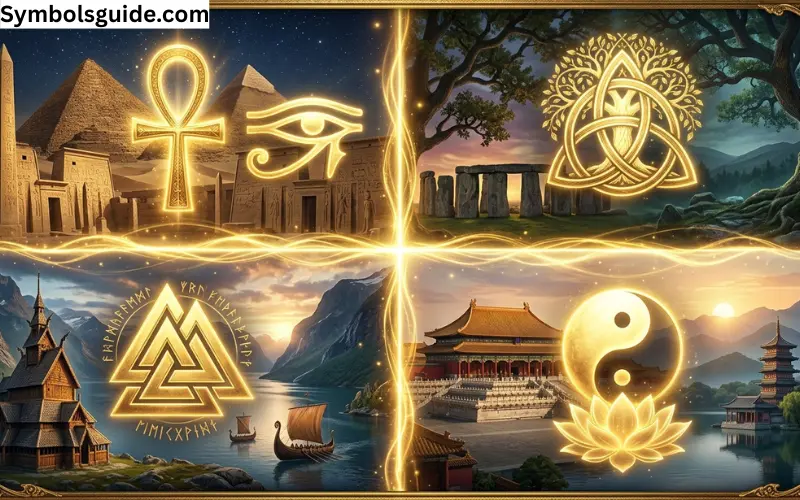
Some ancient symbols became globally recognized because their meanings connected deeply with protection, rebirth, spirituality, wisdom, healing, and transformation.
Many of these sacred emblems survived for centuries through mythology, religious traditions, tattoos, artwork, and storytelling.
1. The Ankh Symbol
Meaning
The Ankh is one of the most recognizable Egyptian emblems.
It represents:
- Life
- Immortality
- Spiritual energy
- Rebirth
- Divine wisdom
Ancient Egyptians often called it the “Key of Life.”
Temple carvings and tomb artwork frequently showed gods and pharaohs holding the Ankh.
Spiritual Interpretation
The Ankh is deeply connected with eternal existence and the belief that life continues beyond death.
Modern spiritual communities often use the Ankh in jewelry, tattoos, and sacred artwork to represent vitality, wisdom, and awakening.
Where It Appears
- Egyptian artwork
- Jewelry
- Tattoos
- Spiritual illustrations
- Mythology-inspired art
2. Ouroboros Symbol
Meaning
The Ouroboros shows a serpent or dragon consuming its own tail.
It symbolizes:
- Eternity
- Infinite cycles
- Transformation
- Renewal
- The cycle of life and death
Psychological Symbolism
Philosophers and psychologists often connect the Ouroboros with personal evolution and self-renewal.
Its circular form reflects the idea that endings often create new beginnings.
Modern Popularity
The Ouroboros frequently appears in:
- Tattoos
- Fantasy artwork
- Gaming culture
- Spiritual books
- Alchemy-inspired designs
3. Tree of Life Symbol
Meaning
The Tree of Life appears throughout Celtic, Norse, Egyptian, and Eastern traditions.
It commonly represents:
- Growth
- Wisdom
- Family bonds
- Stability
- Spiritual balance
- Connection between worlds
Ancient Symbols of Life
Several civilizations believed the Tree of Life connected heaven, Earth, and the underworld.
Its roots and branches symbolized ancestry, growth, and the connection between generations.
Tattoo Symbolism
Tree of Life tattoos often represent:
- Healing
- Family
- Personal growth
- Inner strength
- Spiritual grounding
Image SEO caption: Ancient Tree of Life symbol with Celtic-inspired sacred artwork
4. Eye of Horus Symbol
Meaning
The Eye of Horus is an Egyptian protection emblem associated with awareness, healing, and divine power.
It represents:
- Protection
- Wisdom
- Health
- Spiritual vision
- Inner clarity
Cultural Importance
Ancient Egyptians used the Eye of Horus in jewelry, amulets, and tombs because they believed it protected people from danger and negative energy.
Modern Interpretation
Today, this mystical emblem appears in:
- Jewelry
- Tattoos
- Fashion
- Spiritual artwork
- Mystical aesthetics
People researching Eye of Horus tattoo meanings often connect the design with intuition, protection, and spiritual awareness.
Why People Feel Drawn Toward Ancient Symbols
People are often drawn toward ancient imagery during periods of change, healing, grief, or self-discovery.
Some feel emotionally connected to protective emblems.
Others are fascinated by the mystery surrounding forgotten civilizations and sacred traditions.
For many people, these timeless markings create a feeling of identity, spirituality, nostalgia, and belonging that feels difficult to explain logically.
That emotional connection is one reason ancient iconography continues surviving across generations.
Ancient Symbols in Modern Tattoo Culture
Ancient-inspired tattoos remain extremely popular because they combine history, mystery, spirituality, and personal meaning.
Popular tattoo styles include:
- Minimalist symbol tattoos
- Matching couple tattoos
- Spiritual tattoos
- Memorial tattoos
- Geometric sacred tattoos
Pinterest and tattoo communities frequently feature artwork inspired by mythology, Viking culture, Egyptian spiritual symbols, and sacred geometry.
Many tattoo lovers choose these mystical markings to represent healing, identity, transformation, love, or personal memories.
Ancient Symbols in Dreams and Spiritual Interpretation
Ancient imagery often appears in dreams, meditation practices, and spiritual experiences.
Some people believe recurring sacred signs inside dreams may reflect:
- Emotional healing
- Transformation
- Fear of change
- Spiritual curiosity
- Inner conflict
- Personal growth
Psychological interpretations usually connect dream symbolism with the subconscious mind and emotional experiences.
Spiritual communities sometimes interpret ancient imagery as guidance, protection, or signs connected with transformation.
Ancient Symbols Beginners Often Confuse
Some sacred designs look visually similar, which can confuse beginners exploring symbolic history for the first time.
| Symbol Pair | Why Beginners Confuse Them |
| Ankh vs Cross | Similar shape and structure |
| Valknut vs Celtic Knot | Interlocking design patterns |
| Eye of Horus vs Eye of Ra | Egyptian visual similarities |
| Ouroboros vs Spiral Symbol | Circular symbolic imagery |
Learning historical context usually makes these differences easier to understand.
See Also
FAQs
What are ancient symbols?
Ancient symbols are visual signs created by early civilizations to represent spirituality, beliefs, protection, emotions, life, death, wisdom, and cultural identity.
These sacred markings appeared in mythology, temples, rituals, jewelry, cave art, and historical architecture across many ancient societies.
Historians believe symbolic imagery existed long before formal written language fully developed.
What is the most powerful ancient symbol?
The Ankh, Tree of Life, Eye of Horus, and Ouroboros are often considered among the most powerful ancient emblems because they represent protection, rebirth, wisdom, life, healing, and spiritual transformation.
Different cultures viewed certain sacred signs as symbols of divine power, immortality, or cosmic balance.
What ancient symbol represents life?
The Ankh is one of the most recognized ancient symbols of life.
Ancient Egyptians connected it with immortality, divine energy, spiritual wisdom, and eternal existence beyond death.
Because of these meanings, the Ankh still appears widely in spiritual artwork, jewelry, and tattoo culture today.
What ancient symbol represents death?
The Valknut is strongly associated with death and the afterlife in Norse mythology.
Historians often connect it with Odin, fallen warriors, sacrifice, and spiritual transition.
Some Viking-inspired traditions also interpret the Valknut as a symbol of courage and destiny.
Conclusion
Some ancient symbols disappeared with the civilizations that created them.
Others survived wars, collapsing empires, changing religions, and thousands of years of human history.
Even today, these mysterious markings continue appearing in tattoos, jewelry, mythology, spiritual artwork, and personal stories because they still express emotions many people struggle to explain with words alone.
For some, they represent healing.
For others, protection, identity, memory, spirituality, or personal transformation.
That lasting emotional connection is the reason ancient symbols still feel powerful today.
They are not just forgotten designs from the past.
They are timeless reminders of humanity’s endless search for meaning, belonging, and understanding.