
Multimeter symbols are electrical icons used to measure voltage, current, resistance, continuity, capacitance and other electrical values safely.
The most important multimeter symbols beginners should learn first include:
- V~ = AC voltage
- V⎓ = DC voltage
- Ω = resistance
- 🔔 = continuity
- A = current
Learning these basic symbols makes electrical testing dramatically easier and safer.
Electricity becomes dangerous the moment people stop understanding what they are looking at.
That is exactly why multimeter symbols matter.
For beginners, a multimeter often feels intimidating at first glance.
Tiny icons.
Confusing dial settings.
Electrical abbreviations.
Symbols that seem impossible to memorize.
One wrong setting can create inaccurate readings, damaged components or even serious electrical safety risks.
Yet every multimeter symbol exists for one simple reason:
to help humans measure electricity safely and accurately.
Long before modern digital multimeters existed, electricians and engineers created standardized electrical markings that could be understood across workshops, laboratories, homes and industrial systems worldwide.
Today, those same multimeter symbols still appear on:
- digital multimeters
- analog multimeters
- Fluke multimeters
- automotive multimeters
- clamp meters
- continuity testers
- industrial diagnostic tools
Whether someone is testing a battery, diagnosing a car, troubleshooting home wiring or learning electronics for the first time, understanding multimeter symbols remains one of the most important electrical skills.
Most Important Multimeter Symbols at a Glance
| Symbol | Meaning | Common Use |
| V~ | AC voltage | Wall outlets |
| V⎓ | DC voltage | Batteries |
| A~ | AC current | Home appliances |
| A⎓ | DC current | Automotive systems |
| Ω | Resistance | Circuit testing |
| 🔔 | Continuity | Wire testing |
| ➝ | — | Diode test |
| Hz | Frequency | Generators |
| F | Capacitance | Capacitors |
| °C | Temperature | HVAC systems |
| COM | Common port | Black probe input |
| 10A | High current | Large current testing |
What Are Multimeter Symbols?
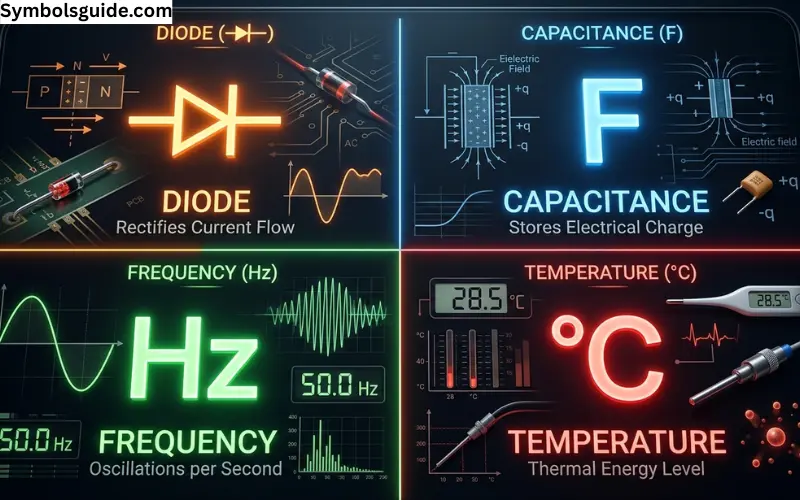
Multimeter symbols are standardized electrical icons used to represent different measurement functions on a multimeter.
These symbols help users identify settings used for:
- voltage
- current
- resistance
- continuity
- capacitance
- frequency
- temperature
- diode testing
- transistor testing
Instead of printing long electrical terms across the dial, manufacturers use universal symbols understood across different countries and languages.
That is why most multimeters around the world look surprisingly similar.
Once users understand these markings, operating a multimeter becomes faster, safer and far less confusing.
Why Knowing Multimeter Symbols Matters
Many beginners rotate the dial without fully understanding the symbols.
That mistake can lead to:
- inaccurate readings
- blown fuses
- damaged circuits
- short circuits
- damaged electronics
- electrical hazards
Professional electricians rely heavily on symbol recognition because quick understanding saves time during troubleshooting.
Understanding multimeter symbols helps users:
- measure electricity safely
- diagnose wiring problems
- troubleshoot faster
- protect sensitive electronics
- avoid beginner mistakes
- use advanced features confidently
The better someone understands the symbols, the safer electrical testing becomes.
How to Read a Multimeter Dial
Many beginners struggle because the multimeter dial contains multiple electrical symbols packed closely together.
Understanding the dial layout makes learning much easier.
Identify Voltage Settings
Most multimeters place voltage settings near the top of the dial.
Look for:
- V~ for AC voltage
- V⎓ for DC voltage
These settings are used most often.
Learn Resistance and Continuity
Next, identify:
- Ω for resistance
- 🔔 for continuity
These settings help troubleshoot wires, switches and electronic components.
Know Current Settings
Current settings usually include:
- A
- mA
- µA
These settings often require moving the probe into a different port.
Many beginners accidentally blow fuses by forgetting this step.
Practice Using Safe Devices
Beginners should practice on:
- AA batteries
- unplugged electronics
- safe low-voltage devices
- small LED circuits
before testing household electrical systems.
Multimeter Input Port Symbols
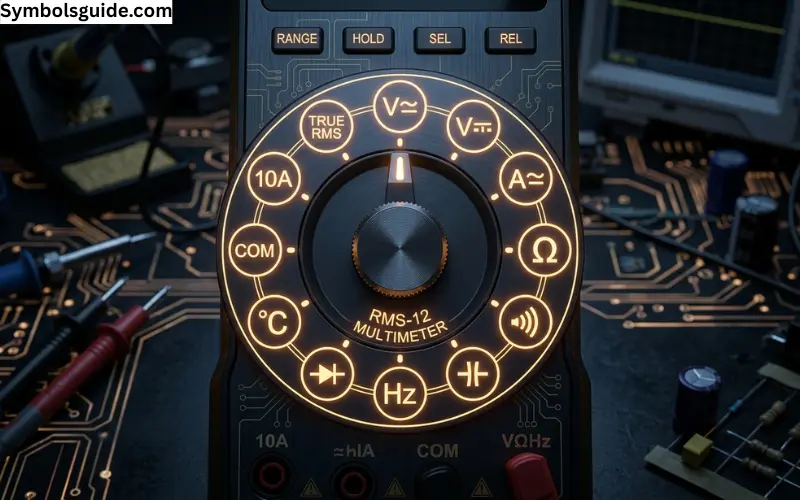
Many beginners focus only on the dial and forget the probe ports also contain important symbols.
Understanding input ports prevents some of the most common multimeter mistakes.
COM Port Symbol
Meaning
COM stands for common terminal.
Important Rule
The black probe almost always connects to the COM port.
Why It Matters
Nearly every measurement depends on the COM connection.
VΩ Port Symbol
Meaning
Used for:
- voltage
- resistance
- continuity
- diode testing
Beginner Tip
Most basic electrical measurements use this port.
mA Port Symbol
Meaning
Used for small current measurements.
Common Uses
- electronics
- sensors
- LED circuits
10A Port Symbol
Meaning
Used for higher current measurements.
Safety Importance
This port protects the multimeter during large current testing.
101+ Multimeter Symbols and Meanings
Below are the most important multimeter symbols explained in beginner-friendly language with practical examples.
Voltage Multimeter Symbols
Voltage is one of the most commonly measured electrical values.
Understanding voltage symbols is extremely important because confusing AC and DC settings remains one of the biggest beginner mistakes.
V~ Symbol
Meaning
The V~ symbol represents AC voltage.
Real-Life Uses
This setting is commonly used for:
- wall outlets
- household wiring
- refrigerators
- washing machines
- air conditioners
- extension cords
Beginner Safety Tip
Most household electricity uses AC voltage.
Using the wrong mode may produce inaccurate readings.
V⎓ Symbol
Meaning
The V⎓ symbol represents DC voltage.
Common Beginner Uses
Beginners often use this setting while testing:
- AA batteries
- car batteries
- phone chargers
- LED strips
- solar systems
- electronic circuits
Why It Matters
Battery testing almost always uses the DC voltage setting.
mV Symbol
Meaning
The mV symbol means millivolts.
Why Professionals Use It
This setting measures extremely small voltage levels inside sensitive electronics and sensors.
Common Applications
- motherboard repair
- sensor testing
- audio electronics
- precision circuits
Auto Voltage Symbol
Some modern digital multimeters automatically detect AC or DC voltage.
Why Beginners Like It
Auto-detection reduces beginner mistakes and simplifies electrical testing.
Current Multimeter Symbols
Current symbols help measure how much electrical flow moves through a circuit.
Unlike voltage testing, current measurement often requires breaking the circuit connection.
That is why understanding current symbols is extremely important.
A~ Symbol
Meaning
Measures AC current.
Common Real-Life Uses
- HVAC systems
- industrial motors
- home appliances
- electrical panels
Beginner Warning
Always check probe placement before measuring current.
A⎓ Symbol
Meaning
Measures DC current.
Common Uses
- automotive electronics
- solar equipment
- LED systems
- battery-powered devices
mA Symbol
Meaning
Represents milliamps.
Common Examples
- remote controls
- sensors
- LED circuits
- computer boards
µA Symbol
Meaning
Represents microamps.
Common Applications
- laboratory equipment
- medical electronics
- sensitive sensors
- precision electronics
10A Symbol
Meaning
Used for higher current measurements.
Common Uses
- automotive testing
- power tools
- larger appliances
Resistance Multimeter Symbols
Resistance settings help determine how strongly a material opposes electrical current.
These symbols are essential in electronics troubleshooting.
Ω Symbol
Meaning
The Ω symbol represents resistance measured in ohms.
Real-Life Uses
Resistance testing helps identify:
- broken wires
- damaged resistors
- faulty heating elements
- burned components
- wiring problems
Important Safety Warning
Never measure resistance on a live powered circuit.
kΩ Symbol
Meaning
Represents kilo-ohms.
Common Uses
- resistor testing
- electronics repair
- circuit diagnostics
MΩ Symbol
Meaning
Represents mega-ohms.
Common Applications
- insulation testing
- industrial systems
- high-voltage equipment
Continuity Multimeter Symbols
Continuity testing became one of the internet’s most searched multimeter functions because it quickly identifies broken electrical connections.
🔔 Continuity Symbol
Meaning
The continuity symbol usually looks like a bell or sound-wave icon.
What It Does
The multimeter beeps when electrical continuity exists.
Real-Life Uses
- checking fuses
- testing wires
- troubleshooting switches
- diagnosing cables
Example of Continuity Testing
If a wire is broken internally, the continuity setting will not beep.
If the wire is healthy, the multimeter produces a beep showing electricity can flow correctly.
This simple feature makes continuity testing one of the fastest ways to locate wiring problems.
Sound Wave Symbol
Some multimeters use a sound-wave icon instead of a bell.
Both symbols represent continuity testing.
Diode Multimeter Symbols
Diode symbols confuse many beginners because they look technical at first glance.
But their purpose is actually simple.
➝|— Diode Symbol
Meaning
Tests whether a diode allows electrical flow correctly.
Why It Matters
Faulty diodes can damage:
- power supplies
- chargers
- televisions
- automotive electronics
- motherboards
Beginner Explanation
A healthy diode allows current to move in one direction while blocking it in the opposite direction.
Capacitance Multimeter Symbols
Modern electronics heavily depend on capacitors.
That is why capacitance symbols appear on many advanced multimeters.
F Symbol
Meaning
Represents capacitance measured in farads.
Common Uses
- capacitor testing
- motor repair
- air conditioners
- power circuits
µF Symbol
Meaning
Represents microfarads.
Why It Matters
Most electronic capacitors are measured in microfarads rather than full farads.
Frequency Multimeter Symbols
As modern electronics evolved, frequency measurement became increasingly important.
Hz Symbol
Meaning
Measures frequency in hertz.
Common Uses
- generators
- audio systems
- AC systems
- signal testing
Beginner Example
Household electricity in many countries operates at either 50Hz or 60Hz.
kHz Symbol
Meaning
Represents kilohertz.
Common Applications
- communication systems
- radio electronics
- signal circuits
Temperature Multimeter Symbols
Some digital multimeters include built-in temperature testing features.
°C Symbol
Meaning
Measures temperature in Celsius.
Common Uses
- HVAC repair
- engine diagnostics
- industrial systems
°F Symbol
Meaning
Measures temperature in Fahrenheit.
What Is True RMS on a Multimeter?
TRUE RMS is one of the most important advanced multimeter features.
Many cheap multimeters struggle to measure unstable AC waveforms accurately.
TRUE RMS technology solves that problem.
Why TRUE RMS Matters
Professional electricians use TRUE RMS multimeters because they provide more accurate readings when testing:
- variable speed motors
- HVAC systems
- industrial electronics
- unstable AC signals
Without TRUE RMS, readings may become inaccurate.
That is why TRUE RMS became a major feature in professional electrical testing.
Fluke Multimeter Symbols Explained
Fluke multimeters are considered some of the world’s most trusted professional electrical tools.
Although most Fluke multimeter symbols follow universal standards, advanced models include additional professional features.
LoZ Symbol
Meaning
Low impedance mode.
Why Electricians Use It
Helps eliminate ghost voltage readings during troubleshooting.
HOLD Symbol
Meaning
Freezes the reading on screen.
MIN/MAX Symbol
Meaning
Records minimum and maximum readings.
REL Symbol
Meaning
Relative mode.
What It Does
Allows comparison between current readings and reference measurements.
NCV Symbol
Meaning
Non-contact voltage detection.
Safety Advantage
Allows users to detect live voltage without touching exposed wires.
Digital Multimeter Symbols Explained
Modern digital multimeters contain far more symbols than older analog models.
Many advanced meters now include:
- auto-ranging
- Bluetooth connectivity
- smart detection
- backlight systems
- data logging
- non-contact voltage testing
Understanding these symbols helps users operate modern multimeters more confidently.
Auto Range Symbol
Meaning
Automatically selects the correct measurement range.
Why Beginners Prefer It
Reduces confusion and improves measurement accuracy.
Bluetooth Symbol
Meaning
Connects the multimeter with smartphones or computers.
Modern Advantage
Allows reading storage and remote monitoring.
Analog vs Digital Multimeter Symbols
| Feature | Analog Multimeter | Digital Multimeter |
| Display | Needle | LCD screen |
| Symbol Complexity | Lower | Higher |
| Accuracy | Moderate | High |
| Beginner Friendly | Medium | High |
| Reading Speed | Slower | Faster |
| Advanced Features | Limited | Extensive |
Some technicians still prefer analog meters because moving needle behavior helps reveal fluctuating electrical changes visually.
Automotive Multimeter Symbols
Automotive multimeters contain specialized settings designed for vehicles.
These symbols help mechanics diagnose electrical problems faster.
RPM Symbol
Meaning
Measures engine revolutions per minute.
Duty Cycle % Symbol
Meaning
Measures pulse-width signals inside automotive electronics.
Battery Symbol
Meaning
Used for battery testing and charging diagnostics.
Most Confusing Multimeter Symbols for Beginners
Some multimeter settings look extremely similar at first glance.
That confusion causes many beginner mistakes.
V~ vs V⎓
- V~ measures AC voltage
- V⎓ measures DC voltage
Continuity vs Resistance
- Continuity checks electrical flow
- Resistance measures opposition to current
mA vs A
- mA measures small current
- A measures larger current
Using the wrong current port may blow the multimeter fuse.
Quick Multimeter Symbols Reference Library
| Symbol | Meaning |
| nF | Nanofarads |
| pF | Picofarads |
| hFE | Transistor gain |
| SEL | Select function |
| APO | Auto power off |
| LIVE | Live wire detection |
| MAX | Maximum reading |
| MIN | Minimum reading |
| PEAK | Peak capture |
| AC | Alternating current |
| DC | Direct current |
| VAC | AC voltage |
| VDC | DC voltage |
| AAC | AC current |
| ADC | DC current |
| OL | Overload |
| AUTO | Auto ranging |
| DATA | Data hold |
| LOW BAT | Low battery warning |
| TEMP | Temperature |
| CAP | Capacitance |
| TRUE RMS | Accurate AC measurement |
| USB | Computer connectivity |
| LIGHT | Screen backlight |
| BEEP | Audible continuity |
| CAT III | Safety category |
| CAT IV | High safety category |
Important Safety Warning
Never test resistance or continuity on a live powered circuit.
Always disconnect electrical power before using:
- Ω settings
- continuity testing
- diode testing
Ignoring this safety rule may damage the multimeter or create electrical hazards.
Common Multimeter Mistakes Beginners Make
Even advanced multimeters become dangerous when used incorrectly.
Common beginner mistakes include:
- selecting AC instead of DC
- placing probes in wrong ports
- testing resistance on live circuits
- measuring current incorrectly
- ignoring CAT safety ratings
- using damaged probes
- touching exposed conductors
Understanding multimeter symbols dramatically reduces these mistakes.
Safety Meanings Behind Multimeter Symbols
Many multimeter symbols exist primarily for electrical safety.
Understanding them is extremely important.
CAT Ratings
Meaning
Safety category ratings.
Examples
- CAT I
- CAT II
- CAT III
- CAT IV
Why They Matter
Higher CAT ratings protect users against dangerous voltage spikes.
Double Insulation Symbol
Meaning
Indicates extra electrical insulation protection.
Warning Triangle Symbol
Meaning
Indicates caution or electrical danger.
Why Users Must Respect It
Ignoring warning symbols may create serious electrical hazards.
Multimeter Symbols PDF Guide
Many beginners print multimeter symbol charts while learning electronics.
Visual repetition improves symbol recognition much faster.
Printable multimeter PDF guides often include:
- voltage symbols
- continuity symbols
- current settings
- Fluke multimeter symbols
- automotive multimeter symbols
- safety markings
Students, electricians and hobbyists frequently use printable charts as quick-reference guides during troubleshooting.
Who Should Learn Multimeter Symbols?
Understanding multimeter symbols benefits far more people than most beginners realize.
These skills are useful for:
- electricians
- engineering students
- automotive technicians
- HVAC beginners
- electronics hobbyists
- solar technicians
- DIY homeowners
- industrial workers
As electronics continue expanding into daily life, electrical testing skills become increasingly valuable.
See Also
- 10 Powerful Celtic Symbols and Their Hidden Meanings
- 7 Virgo Symbols and Meanings That Reveal Inner Power
- Musical Symbols and Meanings for Beginners Guide
- 100+ Ancient Symbols and Meanings Hidden Wisdom Explained
- 110 Ancient Vow Symbols of Love, Loyalty & Trust
FAQs
What do multimeter symbols mean?
Multimeter symbols represent electrical measurement settings like voltage, resistance, continuity, current and capacitance.
What is the continuity symbol on a multimeter?
The continuity symbol usually looks like a bell or sound-wave icon and checks whether electrical flow exists through a wire or circuit.
What does V~ mean on a multimeter?
V~ represents AC voltage used for testing wall outlets and household electricity.
What does V⎓ mean on a multimeter?
V⎓ represents DC voltage used for batteries, vehicles and electronic devices.
What does Ω mean on a multimeter?
The Ω symbol represents electrical resistance measured in ohms.
What are Fluke multimeter symbols?
Fluke multimeter symbols are advanced electrical icons used for professional measurement features like LoZ, NCV and MIN/MAX recording.
Why is my multimeter showing OL?
OL usually means overload or an open circuit condition depending on the selected setting.
What happens if I use the wrong multimeter setting?
Using the wrong setting may create inaccurate readings, blow the fuse or damage the multimeter.
Can a multimeter detect live wires?
Yes. Many modern multimeters include NCV non-contact voltage detection features.
What does auto range mean on a multimeter?
Auto range automatically selects the correct measurement range without manual adjustment.
Which multimeter symbols should beginners learn first?
Beginners should first memorize:
- V~
- V⎓
- Ω
- continuity symbol
- A settings
because these are the most commonly used functions.
Conclusion
Multimeter symbols survived through generations of electrical technology because they solve one critical problem:
helping humans understand electricity safely.
What first appears confusing eventually becomes a standardized electrical language used worldwide.
A simple symbol can reveal:
- live voltage
- broken circuits
- hidden electrical faults
- resistance problems
- dangerous current
- safe operation
From professional Fluke multimeters to beginner digital testers, these symbols continue guiding electricians, engineers, mechanics and hobbyists through modern electrical systems every single day.
A bell symbol becomes continuity.
An omega symbol becomes resistance.
A voltage marking becomes electrical understanding.
The more symbols someone recognizes, the safer and more confident they become while working with electricity.
Once users understand the symbols, electrical testing becomes safer, faster and far more accurate.