Guitar TAB symbols are notation marks that show how notes should be played, helping guitarists understand techniques like bends, slides, hammer-ons, pull-offs, vibrato, tapping, and palm muting while reading tablature.
Whether you’re a beginner or experienced player, understanding guitar TAB symbols helps you learn songs faster, improve technique, and play music the way it was meant to sound.
Relate Post: Digital Logic Symbols
Most Common Guitar TAB Symbols at a Glance
| Symbol | Meaning |
| h | Hammer-On |
| p | Pull-Off |
| b | Bend |
| r | Bend Release |
| / | Slide Up |
| \ | Slide Down |
| ~ | Vibrato |
| PM | Palm Mute |
| x | Dead Note |
| T | Tapping |
| tr | Trill |
| < > | Natural Harmonic |
Why Guitar TAB Symbols Matter
| Benefit | Why It Matters |
| Better Accuracy | Helps reproduce songs correctly |
| Faster Learning | Makes tabs easier to understand |
| Improved Technique | Teaches proper guitar articulation |
| Better Expression | Captures emotion and feel |
| Universal Understanding | Used across most TAB platforms |
| Stronger Timing | Improves rhythm interpretation |
Basic Guitar TAB Symbols
1. Fret Number Symbol
Numbers indicate exactly which fret should be pressed on a specific string, providing the foundation for reading guitar tablature.
2. Open String Symbol (0)
The number zero tells the guitarist to play the string without fretting any note, allowing its natural pitch to ring freely.
3. String Line Symbol
Each horizontal line represents one guitar string, creating a visual map of the instrument directly within the tablature.
4. High E String Line
The top TAB line corresponds to the thinnest string, commonly used for melodies, bends, and lead guitar phrases.
5. B String Line
This line represents the second string and frequently carries melody notes, chord extensions, and expressive bends.
6. G String Line
The G string often bridges rhythm and lead playing, making it one of the most versatile strings in standard tuning.
7. D String Line
Located near the center of the guitar’s range, the D string commonly supports riffs, rhythm parts, and melodic transitions.
8. A String Line
The A string plays a major role in power chords, bass movement, and rhythm guitar foundations.
9. Low E String Line
The bottom TAB line represents the thickest string, producing the deep tones heard in riffs and heavy rhythm parts.
10. Bar Line (|)
Vertical lines separate measures, helping players follow song structure and rhythmic organization more easily.
TAB Structure Symbols Summary
| Symbol Type | Purpose |
| Numbers | Fret positions |
| 0 | Open string |
| String Lines | Guitar strings |
| Bar Line | Measure separation |
| TAB Layout | Visual fretboard map |
Legato Symbols
11. Hammer-On (h)
A hammer-on creates a higher note by striking a fret firmly with the fretting hand instead of picking again.
Example: 5h7
12. Pull-Off (p)
A pull-off sounds a lower note by releasing a finger from the string while maintaining vibration.
Example: 7p5
13. Hammer-On and Pull-Off Combination
This combination creates smooth note movement and is heavily used in blues, rock, and shred guitar styles.
14. Trill (tr)
A trill involves rapid hammer-ons and pull-offs between two nearby notes, producing a fast and ornamented effect.
15. Legato Slur
A curved marking may indicate that multiple notes should connect smoothly without distinct picking attacks.
16. Legato Phrase
Extended legato passages prioritize fluidity and speed by minimizing pick strokes and relying on fretting-hand technique.
Slide Symbols
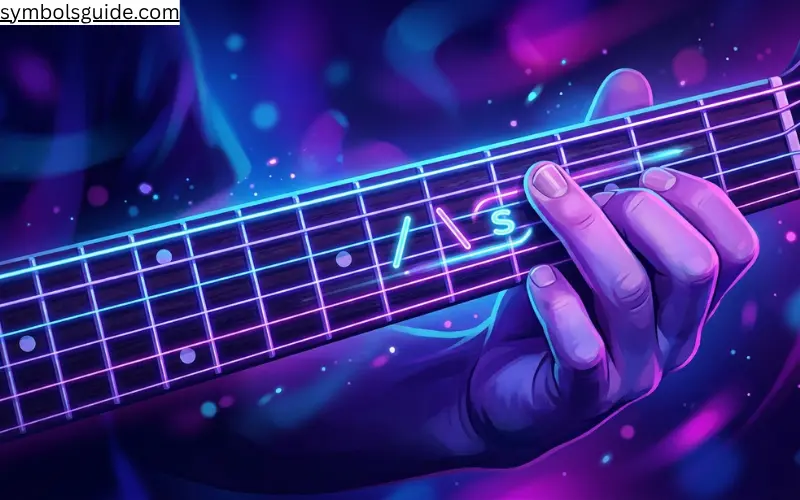
17. Slide Up (/)
This symbol shows movement from a lower fret toward a higher fret while maintaining contact with the string.
Example: 5/7
18. Slide Down ()
A downward slide moves from a higher fret to a lower fret in one continuous motion.
Example: 7\5
19. Shift Slide (s)
Often used in modern tablature, the letter s indicates a position-changing slide between two notes.
20. Slide Into Note
The guitarist approaches a target note by sliding from an unspecified lower fret, creating a smooth entrance.
21. Slide Out of Note
This technique exits a note by sliding away from the written fret instead of stopping abruptly.
22. Legato Slide
A legato slide connects two notes without additional picking, preserving sustain and smooth phrasing.
Core Guitar Techniques Covered So Far
| Category | Symbols |
| TAB Basics | Numbers, Strings, Bar Lines |
| Legato | h, p, tr |
| Slides | /, , s |
| Beginner Skills | Hammer-Ons, Pull-Offs, Slides |
| Reading Fundamentals | TAB Structure |
Bend Symbols
23. Bend (b)
A bend raises a note’s pitch by pushing or pulling the string across the fretboard. It is one of the most expressive techniques in lead guitar playing.
Example: 7b9
24. Bend Release (r)
After reaching the target pitch, the guitarist releases the string back to its original note, creating a vocal-like effect.
Example: 7b9r7
25. Half-Step Bend
This bend raises the pitch by one semitone, producing a subtle blues-inspired inflection without dramatically changing the note.
26. Full-Step Bend
A full-step bend raises the pitch by two frets and is one of the most frequently used bends in rock and blues solos.
27. One-and-a-Half-Step Bend
This wider bend raises the pitch by three semitones and creates dramatic, emotionally charged lead phrases.
28. Two-Step Bend
A challenging technique that raises the pitch by four semitones, often used by advanced players for powerful melodic statements.
29. Pre-Bend (pb)
The string is bent before being picked, allowing the note to begin at the raised pitch rather than moving toward it.
30. Unison Bend
One note is bent until it matches the pitch of another note played simultaneously, creating a rich and harmonized sound.
Vibrato Symbols
31. Vibrato (~)
The tilde symbol tells the guitarist to sustain a note while applying controlled pitch variation for greater expression.
Example: 7~
32. Wide Vibrato
A broad vibrato movement creates dramatic pitch fluctuations commonly heard in classic rock and blues guitar solos.
33. Narrow Vibrato
This subtle vibrato produces a smoother and more refined sound, often used in melodic passages and ballads.
34. Finger Vibrato
Generated by repeatedly moving the fretting finger, finger vibrato helps notes sound more vocal and expressive.
35. Vibrato Bend
Combining vibrato with a bent note adds sustain, emotion, and a singing quality to lead guitar phrases.
Harmonic Symbols
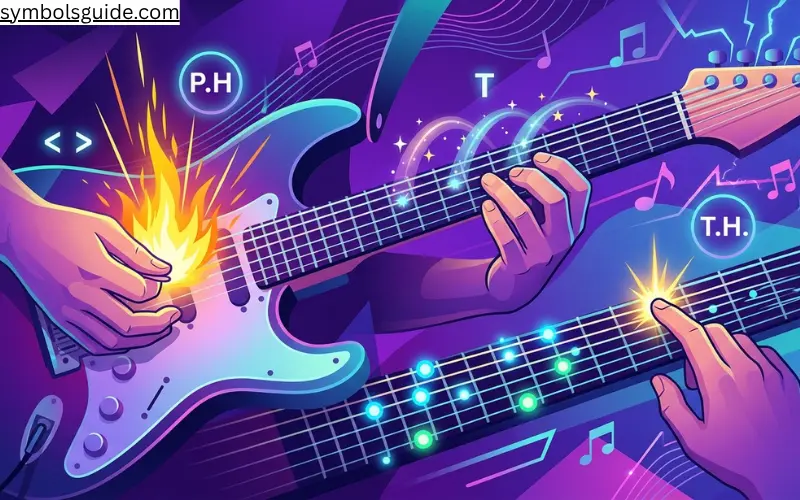
36. Natural Harmonic (< >)
Natural harmonics are produced by lightly touching specific fret locations rather than pressing the string fully.
Example: <12>
37. Artificial Harmonic (A.H.)
Created by fretting a note while simultaneously producing a harmonic overtone with the picking hand.
38. Pinch Harmonic (P.H.)
A popular rock and metal technique that creates a sharp, screaming overtone often heard in guitar solos.
39. Tap Harmonic (T.H.)
Generated by tapping a harmonic node with a finger from the picking hand while another note rings.
40. Harp Harmonic
A fingerstyle technique that combines fretted notes and harmonics to produce a harp-like cascading sound.
41. Harmonic Slide
A harmonic note continues ringing while the guitarist slides to another harmonic position on the neck.
42. Harmonic Vibrato
Applies vibrato to a harmonic note, adding movement and sustain to otherwise delicate harmonic tones.
Tapping Symbols
43. Tapping (T)
The letter T indicates that a note should be played by striking the fretboard directly with a finger from the picking hand.
Example: T12
44. Two-Handed Tapping
Both hands participate on the fretboard, allowing large interval jumps and extremely fast note sequences.
45. Tap and Pull-Off
A tapped note immediately transitions into a pull-off, creating smooth and rapid melodic movement.
46. Tap Slide
After tapping a note, the finger slides to another fret before releasing, extending the phrase naturally.
47. Tap Harmonic Sequence
A series of harmonics generated through repeated tapping techniques, often used in advanced instrumental guitar pieces.
Lead Guitar Symbols at a Glance
| Category | Symbols |
| Bends | b, r, pb, Unison Bend |
| Vibrato | ~, Wide Vibrato, Narrow Vibrato |
| Harmonics | < >, A.H., P.H., T.H. |
| Tapping | T, Tap Slide, Two-Handed Tapping |
| Expression | Vibrato Bend, Harmonic Vibrato |
Why These Symbols Matter
Most memorable guitar solos are built around the techniques covered in this section.
- Bends make notes feel emotional and vocal.
- Vibrato adds life and sustain.
- Harmonics create unique bell-like and screaming tones.
- Tapping expands speed, range, and creativity.
Learning these symbols helps guitarists move beyond simply playing notes and start capturing the character, phrasing, and expression that make great performances memorable.
Muting Symbols
48. Dead Note (x)
The x symbol represents a muted note that creates a percussive sound instead of a clear pitch. It is widely used in funk, rock, and metal rhythm playing.
49. Palm Mute (PM)
Palm muting is performed by lightly resting the picking hand near the bridge, creating a tighter and more controlled tone.
Example: PM——
50. Palm Mute Line
A horizontal line following PM indicates that palm muting should continue across multiple notes or an entire riff section.
51. Left-Hand Mute
The fretting hand lightly touches the strings to stop unwanted ringing and produce clean, controlled rhythm parts.
52. Muted Strum
A chord is strummed while the strings remain muted, creating a rhythmic and percussive effect rather than a defined chord tone.
53. Scratch Note
A heavily muted note used primarily for groove and texture, often heard in funk guitar and rhythmic accompaniment.
Picking Symbols
54. Downstroke (∨)
This symbol indicates that the pick should move downward across the strings, producing a strong and consistent attack.
55. Upstroke (∧)
An upstroke requires the pick to travel upward through the strings and is essential for efficient rhythm playing.
56. Alternate Picking
Shows that downstrokes and upstrokes should alternate, helping players improve speed, accuracy, and endurance.
57. Economy Picking
A technique that combines alternate picking with directional picking to reduce unnecessary hand movement during fast passages.
Rhythm and Navigation Symbols
58. Let Ring
This instruction tells the guitarist to allow notes or chords to continue ringing naturally while additional notes are played.
59. Staccato (.)
The staccato mark shortens note duration, creating a detached and punchy articulation.
60. Accent (>)
An accent indicates that a note should be played with greater force and emphasis than surrounding notes.
61. Marcato (^)
Marcato markings demand an even stronger attack than regular accents, helping important notes stand out clearly.
62. Triplet (3)
The number 3 indicates three evenly spaced notes should fit into the time normally occupied by two notes.
63. Repeat Sign
Directs the guitarist to replay a previously marked section without rewriting the music.
64. Segno
A navigation symbol used in larger musical arrangements to guide players back to a specific location.
65. Coda
The Coda symbol tells the performer to jump to a designated ending section, simplifying complex song structures.
Guitar TAB Symbols Chart
| Symbol | Meaning |
| h | Hammer-On |
| p | Pull-Off |
| b | Bend |
| r | Bend Release |
| / | Slide Up |
| \ | Slide Down |
| ~ | Vibrato |
| PM | Palm Mute |
| x | Dead Note |
| T | Tapping |
| tr | Trill |
| A.H. | Artificial Harmonic |
| P.H. | Pinch Harmonic |
| T.H. | Tap Harmonic |
| < > | Natural Harmonic |
| > | Accent |
| . | Staccato |
| 3 | Triplet |
| Segno | Navigation Marker |
| Coda | Ending Jump |
Guitar TAB Symbols by Category
| Category | Examples |
| TAB Structure | Fret Numbers, Strings, Bar Lines |
| Legato Symbols | Hammer-Ons, Pull-Offs, Trills |
| Slide Symbols | Slide Up, Slide Down, Shift Slide |
| Bend Symbols | Bend, Release, Pre-Bend |
| Vibrato Symbols | Vibrato, Wide Vibrato |
| Harmonic Symbols | Natural, Artificial, Pinch Harmonics |
| Tapping Symbols | Tapping, Tap Harmonics |
| Muting Symbols | Palm Mute, Dead Notes |
| Picking Symbols | Downstroke, Upstroke |
| Rhythm Symbols | Triplets, Accents, Staccato |
| Navigation Symbols | Repeat, Segno, Coda |
Most Important Guitar TAB Symbols
| Rank | Symbol | Why It Matters |
| 1 | h | Essential hammer-on technique |
| 2 | p | Essential pull-off technique |
| 3 | b | Creates expressive lead guitar phrasing |
| 4 | / | Connects notes smoothly |
| 5 | \ | Creates descending slide effects |
| 6 | PM | Critical rhythm guitar technique |
| 7 | ~ | Adds sustain and expression |
| 8 | x | Produces muted rhythmic sounds |
| 9 | T | Foundation of tapping techniques |
| 10 | P.H. | Creates iconic rock and metal harmonics |
Common Mistakes When Reading Guitar TAB Symbols
Confusing Hammer-Ons and Pull-Offs
Many beginners recognize the symbols but accidentally reverse the techniques, causing phrases to sound awkward and unnatural.
Ignoring Rhythm Information
TAB numbers show where to play, but rhythm symbols explain when to play. Missing timing information often changes the entire feel of a song.
Missing Palm Mute Markings
Overlooking PM indicators can completely alter the tightness, punch, and aggression intended in a guitar riff.
Treating Every Bend the Same
Half-step bends, full-step bends, and pre-bends all create different musical effects and should be executed differently.
Misreading Harmonic Symbols
Natural harmonics, artificial harmonics, and pinch harmonics may look related, but each requires a unique playing technique.
Experience & Practical Learning Tips
Many guitarists spend weeks memorizing fret numbers yet overlook the symbols surrounding them. In reality, those symbols often contribute more to the sound of a song than the notes themselves.
A bend can make a solo sound emotional and vocal-like.
A vibrato can make a sustained note come alive.
A palm mute can transform a simple chord progression into a powerful rock riff.
Instead of trying to memorize every symbol at once, learn them gradually while practicing real songs. Associating symbols with actual music makes them easier to remember and apply naturally.
Why Guitar TAB Symbols Improve Your Playing
Learning TAB symbols does much more than improve reading ability.
It teaches phrasing.
It develops technique.
It improves timing.
It helps players understand how professional guitarists shape notes, create emotion, and build memorable performances.
As players become comfortable with TAB notation, they spend less time decoding symbols and more time focusing on musical expression.
See Also
- 113+ One Piece Symbols and Meanings with Names
- 121+ Hanukkah Symbols and Their Meanings with Names
- 128+ Destiny Symbols and Meanings with Names
- 132+ Strong Woman Symbols and Meanings for Inspiration
- 75+ Digital Logic Symbols With Names and Meanings
FAQs
What do guitar TAB symbols mean?
Guitar TAB symbols provide instructions for techniques, articulation, rhythm, dynamics, and expression beyond simple fret numbers.
What does h mean in guitar tabs?
The letter h stands for a hammer-on, where a higher note is sounded without picking the string again.
What does p mean in guitar tabs?
The letter p represents a pull-off that creates a lower note by pulling a finger away from the string.
What does b mean in guitar tabs?
The b symbol indicates a bend that raises the pitch of a note by stretching the string.
What does PM mean in guitar tabs?
PM stands for palm mute, a technique that partially mutes strings with the picking hand.
What does x mean in guitar tabs?
The x symbol usually represents a dead note or muted note used for rhythmic and percussive effects.
What does T mean in guitar tabs?
T indicates tapping, where notes are played directly on the fretboard using the picking hand.
What does ~ mean in guitar tabs?
The tilde symbol represents vibrato, adding controlled pitch variation to a sustained note.
Are guitar tabs easier than sheet music?
Most beginners find TAB easier because it directly shows string and fret positions without requiring traditional music-reading skills.
Do all guitar tabs use the same symbols?
Most modern TAB systems use similar symbols, although small variations can exist between publishers and software programs.
Conclusion
Guitar TAB symbols transform simple fret numbers into complete musical instructions. From hammer-ons and pull-offs to bends, slides, vibrato, harmonics, tapping, muting, and rhythm markings, each symbol plays a role in shaping how a piece of music sounds.
The 65+ real guitar TAB symbols and meanings covered in this guide represent the most important notation marks used in modern tablature. By understanding these symbols, you’ll read tabs more confidently, learn songs faster, improve technique, and capture the expression intended by the original guitarist.
Whether you play rock, blues, metal, country, acoustic, fingerstyle, or modern progressive guitar, mastering TAB symbols is one of the most valuable steps toward becoming a more complete guitarist. 🎸🤝