
Genogram symbols and meanings help people understand much more than basic family relationships. These symbols are used to map family members, emotional connections, health conditions, major life events, and relationship patterns across different generations. In most genograms, a square represents a male, a circle represents a female, and various lines are used to show marriages, divorces, conflicts, support systems, pregnancies, and other family connections. Unlike a traditional family tree, a genogram helps uncover the stories, experiences, and patterns that shape a family over time.
Genogram symbols and meanings provide a practical way to understand how families are connected beyond simple biological relationships. A family tree can show who belongs to a family, but it often stops there. A genogram goes a step further by highlighting emotional bonds, recurring health conditions, family challenges, support systems, and important events that may influence several generations.
When I first learned about genograms, I honestly thought they were just a more detailed version of a family tree. After spending some time studying them, I realized how much information a few symbols and connecting lines could reveal. Something as simple as a line between two people could tell a story about support, conflict, distance, or a lifelong connection.
That is one reason genograms have become such a valuable tool in fields like counseling, psychology, healthcare, nursing, social work, and family therapy. They help professionals see patterns that might otherwise be overlooked and give families a clearer picture of their own history. Before creating or interpreting a genogram, it is important to understand what the symbols mean and how they are used.
Relared Post: Powerful Spiritual Symbols
My Experience Using a Genogram
One of my earliest experiences with a genogram completely changed the way I looked at family assessments. At first, I expected it to be little more than a chart showing parents, children, and grandparents. Once relationship lines, medical history, and significant life events were added, the diagram became much more meaningful.
In a single family map, it was possible to spot recurring health concerns, identify caregiving responsibilities, and notice communication issues that had affected multiple generations. What would have taken pages of written notes became visible at a glance. That experience helped me understand why therapists, social workers, healthcare professionals, and researchers continue to rely on genograms when they want a deeper understanding of family systems.
Basic Genogram Symbols at a Glance Genogram Symbols Key
| Symbol Type | Meaning |
| Square | Male |
| Circle | Female |
| Diamond | Gender Unspecified |
| Horizontal Line | Marriage |
| Vertical Line | Parent-Child Relationship |
| X Through Symbol | Deceased Person |
| Triangle | Pregnancy Event |
| Shaded Symbol | Medical Condition |
| Double Border | Index Person |
| Dashed Line | Informal Relationship |
Family Tree Genogram Symbols and Their Meanings
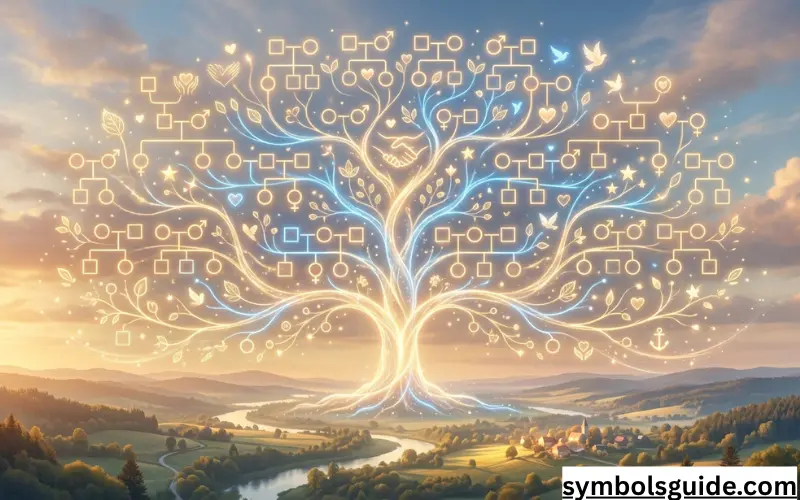
1. Male Symbol
When reading a genogram, you’ll usually notice that male family members are shown with a square. This simple shape may represent a father, son, brother, uncle, grandfather, or any other male relative included in the family history.
2. Female Symbol
When looking at a genogram, a circle typically identifies a female family member. It can stand for a mother, daughter, sister, grandmother, aunt, or any other woman who is part of the family’s story.
3. Unknown Gender Symbol
A diamond is used when a person’s gender is unknown, unavailable, or intentionally left unspecified in family records.
4. Index Person Symbol
A double-bordered symbol highlights the main person being assessed, making it easier to identify the focus of the genogram.
5. Deceased Male Symbol
A square marked with an X represents a male family member who has passed away but remains part of family history.
6. Deceased Female Symbol
A circle with an X indicates a female family member who is deceased while preserving her place in the family diagram.
7. Living Male Symbol
A standard square without additional markings represents a living male relative currently included in the family structure.
8. Living Female Symbol
A standard circle without extra markings represents a living female family member shown within the genogram.
9. Unborn Child Symbol
This symbol identifies a child who has not yet been born but is already included in family planning records.
10. Pregnancy Symbol
The pregnancy symbol indicates that a family member is currently expecting a child and future family addition.
Core Family Structure Symbols
| Symbol Category | Meaning | Example |
| Male | Man or Boy | Father |
| Female | Woman or Girl | Mother |
| Unknown Gender | Gender Not Specified | Missing Record |
| Deceased Male | Dead Male Relative | Grandfather |
| Deceased Female | Dead Female Relative | Grandmother |
| Index Person | Main Subject | Client |
| Pregnancy | Expecting Child | Mother |
| Unborn Child | Not Yet Born | Fetus |
| Twins | Twin Siblings | Twin Children |
| Multiple Births | Three or More Children | Triplets |
Marriage and Relationship Genogram Symbols
11. Marriage Symbol
A horizontal line connecting two individuals typically represents a legally recognized marriage within the family structure.
12. Legal Marriage Symbol
This symbol specifically identifies a formally recognized marriage rather than an informal or non-legal relationship.
13. Common-Law Marriage Symbol
Used for couples who live and function as spouses without participating in a formal marriage ceremony.
14. Engagement Symbol
The engagement symbol shows two individuals who intend to marry but have not yet legally married.
15. Cohabitation Symbol
This symbol represents partners who share a household without being legally married to one another.
16. Separation Symbol
A separation symbol indicates that spouses are living apart while remaining legally married.
17. Divorce Symbol
This symbol shows that a marriage has legally ended through divorce proceedings.
18. Annulment Symbol
An annulment symbol represents a marriage that has been legally declared invalid.
19. Remarriage Symbol
This symbol identifies a new marriage entered after divorce, separation, or the death of a spouse.
20. Widowhood Symbol
Widowhood indicates that one spouse has died while the surviving partner remains alive.
21. Multiple Marriages Symbol
Used when an individual has been married more than once during their lifetime.
22. Long-Term Partnership Symbol
Represents a committed relationship that functions similarly to marriage without formal legal recognition.
23. Casual Relationship Symbol
This symbol identifies a temporary or non-committed romantic relationship within a person’s history.
24. Former Relationship Symbol
A former relationship symbol documents a previous romantic partnership that has ended.
25. Undefined Relationship Symbol
Used when a relationship exists but its exact nature cannot be confirmed.
Common Marriage and Relationship Symbols in a Genogram
| Relationship Type | Meaning |
| Marriage | Married Couple |
| Separation | Living Apart |
| Divorce | Marriage Ended |
| Cohabitation | Living Together |
| Engagement | Future Marriage |
| Widowhood | Partner Deceased |
| Remarriage | New Marriage |
| Partnership | Long-Term Union |
| Casual Relationship | Non-Committed Connection |
| Annulment | Invalid Marriage |
Parent and Child Genogram Symbols and Their Meanings
26. Biological Child Symbol
You’ll usually see this symbol used for a biological son or daughter connected directly to both parents.
27. Firstborn Child Symbol
Identifies the oldest child among siblings and helps maintain accurate birth-order records.
28. Middle Child Symbol
Represents a child born between older and younger siblings within the family structure.
29. Youngest Child Symbol
Used to identify the youngest member of a sibling group.
30. Adopted Child Symbol
You’ll often find this symbol in families where a child became part of the household through a legal adoption process.
31. Foster Child Symbol
Indicates a child receiving temporary care through a foster family arrangement.
32. Stepchild Symbol
This marker helps show blended family relationships formed after remarriage or a long-term partnership.
33. Guardianship Child Symbol
Used when a child is being raised under legal guardianship rather than by biological parents.
34. Child Living Elsewhere Symbol
Identifies a child who remains part of the family but lives in another household.
35. Child in Institutional Care Symbol
Represents a child currently living in a residential facility, treatment center, or similar institution.
36. Twin Children Symbol
Used when two children are born from the same pregnancy.
37. Identical Twins Symbol
Identical twins are shown when both children develop from the same fertilized egg and share the same genetic background.
38. Fraternal Twins Symbol
Used for twins who developed from separate eggs and are genetically similar to regular siblings.
39. Triplets Symbol
Identifies three children born during the same pregnancy.
40. Multiple Births Symbol
Represents four or more children born from a single pregnancy event.
Pregnancy and Birth Genogram Symbols
41. Current Pregnancy Symbol
This symbol shows that a family member is currently expecting a child and preparing for a new addition.
42. Planned Pregnancy Symbol
Represents a pregnancy that was intentionally planned and anticipated by the parents.
43. Unplanned Pregnancy Symbol
Professionals sometimes include this marker when a pregnancy was not originally planned but remains part of the family history.
44. Miscarriage Symbol
Represents a pregnancy loss that occurred before the baby reached viability.
45. Stillbirth Symbol
This symbol identifies a baby born without signs of life during a later stage of pregnancy.
46. Abortion Symbol
Used to document a pregnancy that ended through medical or elective termination.
47. Ectopic Pregnancy Symbol
Represents a pregnancy that developed outside the uterus and required medical attention.
48. Infant Death Symbol
Indicates a child who passed away shortly after birth.
49. Neonatal Death Symbol
Used when a newborn dies during the first few weeks of life.
50. Perinatal Loss Symbol
Represents a loss that occurred shortly before, during, or soon after childbirth.
Pregnancy and Birth Symbols
| Symbol Type | Meaning |
| Pregnancy | Expecting Child |
| Miscarriage | Early Pregnancy Loss |
| Stillbirth | Birth Loss |
| Abortion | Pregnancy Termination |
| Ectopic Pregnancy | High-Risk Pregnancy |
| Infant Death | Early Infant Loss |
| Neonatal Death | Newborn Death |
| Perinatal Loss | Birth-Related Loss |
| Twins | Two Children |
| Triplets | Three Children |
Relationship Genogram Symbols and Emotional Relationship Symbols Explained
51. Very Close Relationship Symbol
Family members connected by this symbol often maintain a strong relationship based on trust, support, and frequent contact.
52. Close Relationship Symbol
Shows a healthy and positive connection between family members without extreme emotional dependence.
53. Distant Relationship Symbol
This connection is commonly used when relatives rarely communicate or have little emotional involvement in each other’s lives.
54. Estranged Relationship Symbol
Represents family members who intentionally avoid contact because of unresolved issues or conflict.
55. Cut-Off Relationship Symbol
Shows a complete breakdown in communication and emotional connection between individuals.
56. Hostile Relationship Symbol
Used when interactions are regularly marked by anger, resentment, or ongoing tension.
57. Conflictual Relationship Symbol
Represents frequent disagreements and recurring arguments within a relationship.
58. Violent Relationship Symbol
Indicates a history of physical violence or serious aggression between family members.
59. Physically Abusive Relationship Symbol
Used when one person has caused physical harm to another within the relationship.
60. Emotionally Abusive Relationship Symbol
Represents repeated emotional harm through manipulation, intimidation, criticism, or humiliation.
61. Sexual Abuse Relationship Symbol
This symbol documents situations involving sexual abuse when relevant to professional assessment.
62. Controlling Relationship Symbol
Indicates that one individual exercises excessive influence over another person’s choices or behavior.
63. Dependent Relationship Symbol
Represents a relationship where one person relies heavily on another for support or decisions.
64. Over-Involved Relationship Symbol
Shows blurred boundaries where family members become excessively involved in each other’s lives.
65. Supportive Relationship Symbol
People linked by this symbol generally provide emotional support and practical help when needed.
66. Caring Relationship Symbol
Indicates a nurturing relationship characterized by compassion, concern, and emotional availability.
67. Reconciled Relationship Symbol
Used when family members have repaired a previously strained or damaged relationship.
68. Competitive Relationship Symbol
Represents rivalry, comparison, or ongoing competition between family members.
69. Jealous Relationship Symbol
Shows that envy or feelings of unfairness influence interactions between individuals.
70. Distrustful Relationship Symbol
Indicates low trust, uncertainty, and difficulty relying on another family member.
Emotional Relationship Symbols
| Relationship Type | Meaning |
| Very Close | Strong Emotional Bond |
| Close | Healthy Connection |
| Distant | Limited Contact |
| Estranged | No Meaningful Relationship |
| Hostile | Frequent Conflict |
| Supportive | Positive Relationship |
| Dependent | One-Sided Reliance |
| Competitive | Ongoing Rivalry |
| Distrustful | Lack of Trust |
| Abusive | Harmful Interaction |
Additional Emotional Relationship Symbols
71. Fused Relationship Symbol
Represents extreme emotional closeness where personal boundaries become difficult to maintain.
72. Protective Relationship Symbol
Shows that one family member consistently protects or looks after another.
73. Mentoring Relationship Symbol
Indicates guidance, advice, and personal development support from one individual to another.
74. Caregiver Relationship Symbol
Represents a relationship centered on providing ongoing physical, emotional, or practical care.
75. Reciprocal Support Relationship Symbol
Shows balanced support where both individuals help and encourage each other equally.
Medical, Mental Health, and Social Behavioral Genogram Symbols
76. Diabetes Indicator Symbol
Used to identify family members diagnosed with diabetes and track hereditary health patterns.
77. Hypertension Indicator Symbol
Represents individuals with high blood pressure documented within the family history.
78. Heart Disease Symbol
Medical genograms commonly use this symbol to track heart-related conditions that appear across generations.
79. Cancer Indicator Symbol
Used to document cancer diagnoses that may reveal hereditary health risks across generations.
80. Stroke History Symbol
Represents individuals who have experienced a stroke or significant cerebrovascular event.
Medical, Mental Health, and Social Behavioral Genogram Symbols
81. Kidney Disease Symbol
Healthcare-focused genograms often use this symbol to highlight kidney diseases that appear within the family.
82. Asthma Indicator Symbol
Used to document asthma and recurring respiratory conditions that appear within family histories.
83. Genetic Disorder Symbol
Indicates a diagnosed genetic condition that may affect multiple generations of a family.
84. Disability Symbol
Represents individuals living with physical, intellectual, developmental, or functional disabilities.
85. Chronic Illness Symbol
Used for long-term health conditions that require ongoing treatment or management.
Mental Health Genogram Symbols
86. Mental Health Diagnosis Symbol
Identifies a family member who has received a recognized mental health diagnosis.
87. Depression Indicator Symbol
This marker helps document a history of depression and may reveal mental health patterns across generations.
88. Anxiety Disorder Symbol
Used to document anxiety-related conditions that may influence family well-being.
89. Bipolar Disorder Symbol
Indicates a diagnosis of bipolar disorder within the family history.
90. Schizophrenia Symbol
Represents individuals affected by schizophrenia or related psychotic disorders.
91. Dementia Indicator Symbol
Used to identify cognitive decline and dementia-related conditions among family members.
92. Alzheimer’s Disease Symbol
Specifically represents family members diagnosed with Alzheimer’s disease.
93. Substance Use Disorder Symbol
Counselors and social workers often include this symbol when addiction has played a meaningful role in someone’s life story.
94. Alcohol Dependency Symbol
Represents a history of alcohol addiction or long-term alcohol-related struggles.
95. Smoking Indicator Symbol
Used to document tobacco use that may contribute to family health risks.
Medical and Mental Health Symbols
| Symbol Type | Meaning |
| Diabetes | Blood Sugar Disorder |
| Hypertension | High Blood Pressure |
| Heart Disease | Cardiovascular Condition |
| Cancer | Cancer Diagnosis |
| Stroke | Cerebrovascular Event |
| Depression | Mood Disorder |
| Anxiety | Anxiety Condition |
| Bipolar Disorder | Mood Instability |
| Dementia | Cognitive Decline |
| Substance Use | Addiction History |
Social and Behavioral Genogram Symbols
96. Criminal History Symbol
This notation records significant legal issues that may have influenced family relationships or life circumstances.
97. Incarceration Symbol
Indicates time spent in prison, jail, or another correctional institution.
98. Military Service Symbol
This notation highlights family members who have served in the military and whose experiences may have shaped family history.
99. Immigration Symbol
Represents relocation from one country or region to another.
100. Religious Affiliation Symbol
Identifies an individual’s connection to a particular faith or religious community.
Advanced Social and Family History Genogram Symbols
101. Educational Achievement Symbol
Educational achievements can be noted to show academic progress and long-term family trends related to learning.
102. Employment Status Symbol
Represents a person’s work situation, including employment, self-employment, or unemployment.
103. Retirement Symbol
Indicates that a family member has retired from full-time employment.
104. Homelessness Symbol
Represents a period of housing instability or homelessness within a person’s life history.
105. Financial Dependency Symbol
Shows that one individual relies heavily on another for financial support.
106. Caregiver Indicator Symbol
Identifies a family member who regularly provides care to another individual.
107. Domestic Violence History Symbol
Used to document incidents of violence or abuse within a household.
108. Child Protection Involvement Symbol
Indicates involvement with child welfare or protective service agencies.
109. Foster Care History Symbol
Represents an individual who has spent time within the foster care system.
110. Adoption History Symbol
Documents adoption-related experiences that remain important to family history.
111. Immigration History Symbol
Highlights a major migration event that influenced family culture or identity.
112. Military Veteran Symbol
Represents a family member who previously served in the military.
113. Substance Recovery Symbol
Indicates successful recovery from substance misuse or addiction.
114. Long-Term Care Symbol
Represents individuals receiving ongoing support because of age, illness, or disability.
115. Significant Life Event Symbol
Used to document major experiences that shaped an individual or family system.
Professionals Who Commonly Use Genograms
| Profession | Primary Purpose |
| Family Therapists | Analyze Relationship Patterns |
| Social Workers | Assess Family Functioning |
| Counselors | Explore Emotional Influences |
| Psychologists | Understand Mental Health History |
| Nurses | Track Family Medical Conditions |
| Physicians | Evaluate Genetic Risks |
| Genetic Counselors | Identify Hereditary Disorders |
| Researchers | Study Family Trends |
| Educators | Teach Family Assessment Methods |
| Students | Learn Professional Practice |
How to Read a Genogram Correctly
Reading a genogram becomes much easier when you follow a simple step-by-step approach.
Identify the Index Person
Start with the individual who serves as the main focus of the assessment.
Examine Family Structure
Review parents, children, siblings, spouses, and extended relatives.
Analyze Relationship Lines
Pay attention to supportive, distant, conflicted, or estranged connections.
Look for Generational Patterns
Notice repeated behaviors, health conditions, or relationship trends.
Assess Medical History
Check for hereditary illnesses and recurring health concerns.
Review Social Factors
Consider education, employment, caregiving roles, and major life events.
Common Mistakes When Using Genogram Symbols
Many beginners make a few avoidable mistakes when creating their first genogram.
Treating It Like a Family Tree
A genogram includes emotional, social, and medical information, not just family connections.
Ignoring Relationship Symbols
Relationship lines often provide the most valuable insights within the diagram.
Forgetting Birth Order
Children should generally appear from oldest to youngest.
Using Inconsistent Symbols
Following one symbol system keeps the genogram clear and easy to interpret.
Leaving Out Major Events
Important experiences such as divorce, illness, loss, or adoption should be included.
Genogram vs Family Tree Symbols
| Feature | Genogram | Family Tree |
| Family Structure | Yes | Yes |
| Medical History | Yes | No |
| Emotional Relationships | Yes | No |
| Behavioral Patterns | Yes | No |
| Mental Health Tracking | Yes | No |
| Social Assessment | Yes | No |
| Counseling Use | Yes | Limited |
| Healthcare Use | Yes | Limited |
See Also
- 126 Mayan Symbols and Meanings With Names Explained
- 124 Anime Symbols & Meanings: Names, Logos & Hidden Signs
- 111+ Planetary, Celestial & Alchemy Symbols Meanings
- 97+ Occult Symbols and Meanings With Names & Secrets
- 115+ Powerful Spiritual Symbols & Meanings Hidden Wisdom
FAQs
What is the most common genogram symbol?
The square and circle are the most frequently used symbols. A square represents a male, while a circle represents a female family member.
What do relationship lines mean in a genogram?
Relationship lines show emotional connections such as support, closeness, conflict, distance, dependency, or estrangement.
How many symbols are used in a genogram?
There is no universal limit. Basic genograms may use fewer than 20 symbols, while advanced versions can include more than 100.
Are genogram symbols standardized?
Most core symbols follow widely accepted standards, although some organizations use additional custom symbols.
What is the difference between a family tree and a genogram?
A family tree shows ancestry, while a genogram includes relationships, health history, behaviors, and social influences.
Why do social workers use genograms?
Social workers use genograms to understand family dynamics, support systems, caregiving roles, and potential risk factors.
Can genograms show mental health conditions?
Yes. Conditions such as depression, anxiety, bipolar disorder, schizophrenia, and addiction are often documented.
What does a double line mean in a genogram?
A double line usually represents a particularly strong emotional connection between two individuals.
What does a triangle mean in a genogram?
A triangle is commonly associated with pregnancy-related events, including pregnancy, miscarriage, or pregnancy loss.
How many generations should a genogram include?
Most professionals recommend at least three generations to identify meaningful family patterns.
Can genograms show adoption and foster care?
Yes. Special symbols can represent adoption, foster care, guardianship, and blended family relationships.
Are genograms used in healthcare settings?
Yes. Healthcare professionals often use genograms to evaluate family medical history and hereditary risks.
Can genograms help identify hereditary diseases?
Yes. They help reveal recurring conditions such as diabetes, heart disease, cancer, and certain genetic disorders.
Can I create a genogram without professional software?
Absolutely. Many people create genograms using paper, diagram tools, or simple presentation software.
What information should be included in a genogram?
Most genograms include family members, relationships, medical history, major life events, emotional connections, and social factors.
Conclusion
Understanding genogram symbols and meanings makes it easier to explore family relationships, health history, emotional connections, and life experiences across generations. While the symbols themselves are simple, together they create a detailed picture of how families grow, change, and influence one another over time.
Whether you are a student, therapist, social worker, nurse, counselor, researcher, or simply interested in your family’s story, learning these 101+ genogram symbols provides a strong foundation for reading and creating meaningful family diagrams.