Calculus symbols are the mathematical language used to describe change, motion, growth, accumulation, and optimization. From ∫ (integral) and d/dx (derivative) to lim (limit) and ∂ (partial derivative), these symbols help students, engineers, scientists, and programmers solve real-world problems every day.
Ever wondered what symbols like ∫, lim, d/dx, Σ, and ∞ actually mean? These powerful calculus symbols appear in everything from physics and engineering to economics, data science, and artificial intelligence. In this guide, you’ll discover 75+ essential calculus symbols and meanings, explained in a simple, beginner-friendly way. 🚀
Related Post: Historic Anti-Fascist Resistance Symbols
What Calculus Symbols Represent
| Concept | Meaning |
| Change | Measuring variation in quantities |
| Motion | Describing velocity and acceleration |
| Accumulation | Calculating total quantities |
| Optimization | Finding maxima and minima |
| Continuity | Understanding smooth behavior |
| Infinity | Studying unbounded processes |
| Functions | Modeling relationships |
| Analysis | Investigating mathematical behavior |
Most Important Calculus Symbols at a Glance
| Symbol | Meaning |
| ∫ | Integral |
| d/dx | Derivative |
| lim | Limit |
| ∂ | Partial Derivative |
| ∇ | Nabla Operator |
| Δ | Change |
| Σ | Summation |
| ∞ | Infinity |
| dx | Differential |
| f'(x) | First Derivative |
Limits and Continuity Symbols
1. lim
Represents the value a function approaches as the input moves toward a specific point. Limits form the foundation of derivatives and integrals.
2. →
Shows that one quantity approaches another quantity during a limiting process.
3. ∞
Represents infinity, indicating an unbounded process or quantity without a finite endpoint.
4. +∞
Positive infinity used when values increase without bound.
5. −∞
Negative infinity used when values decrease without bound.
6. ε
Epsilon represents an arbitrarily small positive quantity used in rigorous limit and continuity proofs.
7. δ
Delta is paired with epsilon in formal limit definitions to describe allowable input variation.
8. ≈
Indicates approximate equality when exact equality is not required.
9. ≠
Shows that two mathematical expressions are not equal.
10. =
Represents exact equality between quantities or expressions.
11. ≤
Indicates a value is less than or equal to another value.
12. ≥
Indicates a value is greater than or equal to another value.
Key Symbols Used in Limit Problems
| Symbol | Purpose |
| lim | Limit Evaluation |
| → | Approaches |
| ε | Error Tolerance |
| δ | Input Control |
| ∞ | Infinite Behavior |
| ≈ | Approximation |
Derivative Symbols and Meanings
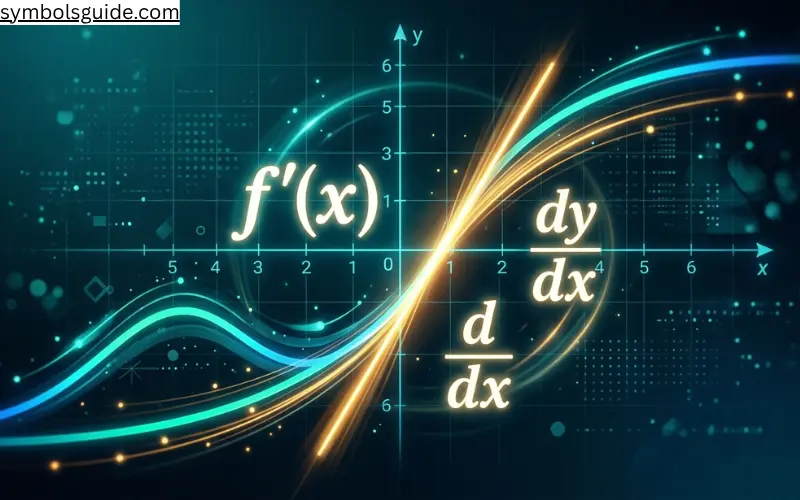
13. d/dx
Leibniz’s derivative operator used to measure instantaneous rates of change.
14. dy/dx
Represents the derivative of y with respect to x.
15. d²y/dx²
Represents the second derivative, often describing acceleration or curvature.
16. d³y/dx³
Represents the third derivative of a function.
17. dⁿ/dxⁿ
General notation for the nth derivative.
18. f'(x)
Lagrange notation for the first derivative of a function.
19. f”(x)
Lagrange notation for the second derivative.
20. f”'(x)
Lagrange notation for the third derivative.
21. y’
Alternative shorthand notation for a derivative.
22. ẏ
Newton’s notation for the first derivative with respect to time.
23. ÿ
Newton’s notation for the second derivative with respect to time.
24. D
General differential operator commonly used in differential equations.
25. Δy/Δx
Represents the average rate of change between two points.
Derivative Symbols Comparison
| Symbol | Common Use |
| d/dx | Differentiation |
| dy/dx | First Derivative |
| d²y/dx² | Second Derivative |
| f'(x) | Function Derivative |
| ẏ | Time Derivative |
| Δy/Δx | Average Change |
| D | Differential Operator |
Integral Symbols and Meanings
26. ∫
The fundamental integral symbol representing continuous accumulation.
27. ∫ᵃᵇ
Definite integral evaluated over a specific interval.
28. ∬
Double integral used for functions involving two variables.
29. ∭
Triple integral used in three-dimensional integration.
30. ∮
Closed contour integral around a loop or closed curve.
31. ∯
Surface integral over a curved surface.
32. ∰
Volume integral over a three-dimensional region.
33. dx
Differential of x indicating the variable of integration.
34. dy
Differential of y.
35. dt
Differential of time.
36. du
Differential commonly used during substitution.
37. dv
Differential often appearing in integration by parts.
38. C
Constant of integration added to indefinite integrals.
Partial Derivative Symbols and Meanings
39. ∂
The partial derivative symbol used when a function depends on multiple variables.
40. ∂f/∂x
Represents the partial derivative of a function with respect to x while holding other variables constant.
41. ∂f/∂y
Represents the partial derivative with respect to y.
42. ∂²f/∂x²
Second partial derivative with respect to x.
43. ∂²f/∂y²
Second partial derivative with respect to y.
44. ∂²f/∂x∂y
Mixed partial derivative involving both x and y.
45. ∂u/∂t
Partial derivative with respect to time, commonly used in heat and wave equations.
46. ∂z/∂x
Measures how z changes as x changes while other variables remain fixed.
47. ∂z/∂y
Measures how z changes as y changes while other variables remain fixed.
Vector Calculus Symbols and Meanings
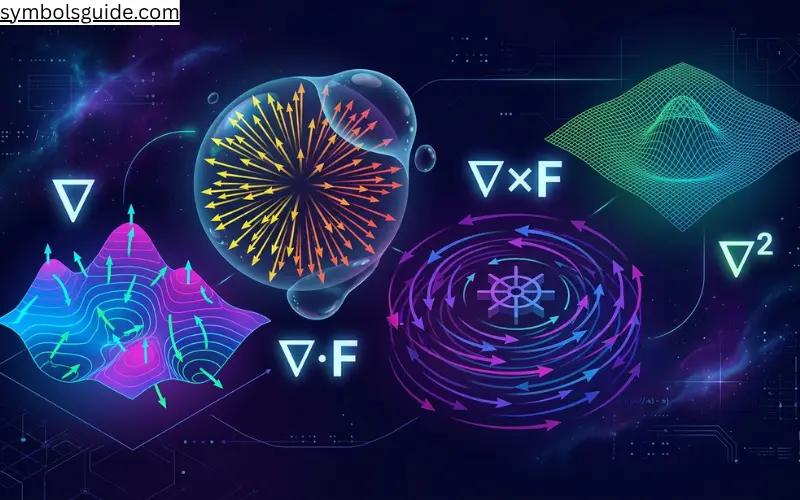
48. ∇
The nabla operator, one of the most important symbols in vector calculus.
49. ∇f
Represents the gradient of a scalar function and points toward the direction of greatest increase.
50. ∇·F
Divergence operator measuring the outward flow of a vector field.
51. ∇×F
Curl operator measuring rotational behavior within a vector field.
52. ∇²
Laplacian operator used in physics, engineering, and differential equations.
53. r⃗
Position vector describing location in space.
54. F⃗
Vector field notation representing a force or directional field.
55. v⃗
Velocity vector showing speed and direction of motion.
56. a⃗
Acceleration vector describing changes in velocity.
57. T⃗
Tangent vector indicating the direction of a curve.
58. N⃗
Normal vector perpendicular to a curve or surface.
59. ds
Differential arc length used in line integrals.
60. dA
Differential area element used in surface integration.
61. dV
Differential volume element used in triple integration.
Vector Calculus Symbols at a Glance
| Symbol | Meaning |
| ∇ | Nabla Operator |
| ∇f | Gradient |
| ∇·F | Divergence |
| ∇×F | Curl |
| ∇² | Laplacian |
| r⃗ | Position Vector |
| v⃗ | Velocity Vector |
| a⃗ | Acceleration Vector |
Infinite Series and Summation Symbols
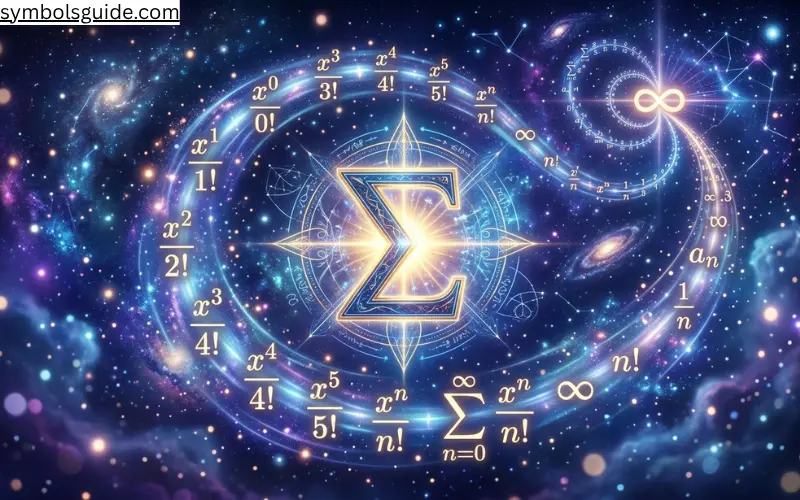
62. Σ
Summation notation used to add a sequence of terms.
63. Π
Product notation used for repeated multiplication.
64. n!
Factorial notation appearing in Taylor series and probability calculations.
65. aₙ
Represents the nth term of a sequence.
66. xₙ
General notation for sequence elements.
67. limₙ→∞
Limit of a sequence as n approaches infinity.
68. Σₙ₌₁∞
Infinite summation notation.
69. Rₙ
Remainder term in a series approximation.
70. Tₙ
Nth partial sum of a series.
Differential Equation Symbols
71. y = y(x)
Indicates that y is a function dependent on x.
72. y’
First derivative appearing in differential equations.
73. y”
Second derivative appearing in higher-order equations.
74. λ
Parameter or eigenvalue frequently used in differential equation solutions.
75. μ
Integrating factor commonly used when solving first-order linear differential equations.
Calculus Symbols by Category
| Category | Examples |
| Limits | lim, ε, δ, ∞ |
| Derivatives | d/dx, dy/dx, f'(x) |
| Integrals | ∫, ∬, ∭, ∮ |
| Partial Derivatives | ∂, ∂f/∂x |
| Vector Calculus | ∇, ∇f, ∇·F |
| Series | Σ, Π, n! |
| Differential Equations | λ, μ, y’ |
History of Major Calculus Symbols
| Symbol | Associated Mathematician | Historical Significance |
| ∫ | Gottfried Wilhelm Leibniz | Derived from the Latin word summa |
| d/dx | Gottfried Wilhelm Leibniz | Foundation of differential calculus |
| f'(x) | Joseph-Louis Lagrange | Alternative derivative notation |
| ẏ | Isaac Newton | Time-based derivative notation |
| Σ | Leonhard Euler | Standardized summation notation |
| ∇ | William Rowan Hamilton | Introduced vector calculus notation |
Calculus Symbols vs Algebra Symbols
| Algebra Symbols | Calculus Symbols |
| x | d/dx |
| y | ∫ |
| + | lim |
| − | ∂ |
| = | ∇ |
| Variables | Rates of Change |
| Expressions | Continuous Processes |
Calculus extends algebra by studying how quantities change continuously rather than simply solving static equations.
See Also
- 128+ Destiny Symbols and Meanings with Names
- 132+ Strong Woman Symbols and Meanings for Inspiration
- 75+ Digital Logic Symbols With Names and Meanings
- 65+ Guitar TAB Symbols and Meanings Every Player Knows
- 67+ Historic Anti-Fascist Resistance Symbols and Meanings
FAQs
What is the most important calculus symbol?
Most mathematicians consider ∫ (integral) and d/dx (derivative) the two foundational symbols of calculus because they represent accumulation and change.
What does the integral symbol mean?
The integral symbol represents continuous accumulation and is commonly used to calculate area, volume, displacement, and total change.
What does d/dx represent?
It represents differentiation with respect to x and measures how rapidly a function changes.
What is the difference between d and ∂?
The symbol d is used for ordinary derivatives involving one variable, while ∂ is used for partial derivatives involving multiple variables.
What does ∇ mean?
The nabla operator is used to calculate gradients, divergence, curl, and other vector calculus operations.
Why is infinity important in calculus?
Infinity plays a central role in limits, convergence, infinite series, and many advanced calculus concepts.
Who invented most calculus notation?
Many foundational symbols were introduced by Gottfried Wilhelm Leibniz, while others were developed by Newton, Lagrange, Euler, and later mathematicians.
Are calculus symbols used in artificial intelligence?
Yes. Modern machine learning relies heavily on derivatives, gradients, optimization methods, and multivariable calculus notation.
Conclusion
Calculus symbols are far more than mathematical shortcuts. They form a universal language that allows mathematicians, scientists, engineers, economists, and data analysts to describe change, motion, accumulation, optimization, and complex relationships with precision. From foundational symbols like lim, d/dx, and ∫ to advanced notations such as ∂, ∇, Σ, and multiple integrals, each symbol represents a powerful idea that helps solve real-world problems.
Whether you are studying introductory calculus, preparing for exams, working in engineering, exploring physics, building machine learning models, or conducting scientific research, understanding these symbols makes formulas easier to read and concepts easier to master. Instead of memorizing equations blindly, learning the meaning behind calculus notation helps you recognize patterns and understand how mathematical systems work.
As calculus continues to play a vital role in modern technology, artificial intelligence, economics, and scientific discovery, becoming familiar with these symbols is one of the most valuable skills any mathematics learner can develop. Keep this guide as a reference whenever you encounter unfamiliar notation, and over time, the language of calculus will become as natural as reading ordinary text.